Introduction
Recruiting young adults for surveys has become increasingly challenging in contemporary survey research (Revilla and Höhne 2020). Declining response rates in traditional surveys and limited coverage of younger cohorts in established panels have led many practitioners to explore alternative recruitment strategies. Social media advertising, particularly on Instagram, has therefore gained popularity as a tool for reaching younger populations (Höhne et al. 2025; Kühne 2020; Neundorf and Öztürk 2023; Whitaker et al. 2017; Zindel et al. 2025). Its broad reach, flexible targeting options, and comparatively low costs make it appear especially suitable for quota-based survey recruitment, which necessarily relies on non-probability sampling designs (Pötzschke and Weiß 2021).
From a practitioner’s perspective, demographic targeting tools offered by platforms such as Meta promise a level of control that seems comparable to traditional quota sampling. Campaigns can be structured around age, gender, and geographic criteria, budgets can be adjusted for specific subgroups, and recruitment progress can be monitored in real time. This has fostered the expectation that quota-based recruitment via social media advertising can be implemented in a relatively straightforward and controllable manner (Neundorf and Öztürk 2022; Pötzschke et al. 2023).
In practice, however, social media recruitment operates within algorithmically optimized advertising systems that prioritize engagement and cost efficiency rather than representativeness or quota fulfillment (Ali et al. 2019, 2021; Bär et al. 2024). As a result, the actual delivery of advertisements may systematically deviate from intended targeting criteria, even when campaigns are carefully designed and actively managed. For survey practitioners, this raises a crucial practical question: how controllable is quota-based recruitment via social media advertising under real-world field conditions?
This article addresses this question by documenting a recruitment campaign that aimed to recruit young adults aged 18 to 29 in Germany via Instagram advertisements while adhering to predefined demographic quotas.
Importantly, the campaign was designed and managed following common practitioner recommendations, including detailed targeting, continuous monitoring, and iterative adjustments throughout the field period. Despite these efforts, substantial deviations from the intended quotas emerged and proved difficult to correct. By documenting this process, the article provides a realistic account of what practitioners can and cannot expect when attempting quota-based recruitment via Instagram advertising.
Background: What we know – and what remains uncertain
Quota-based recruitment is widely used in survey research when probability-based sampling is not feasible. In non-probability designs, quotas are commonly applied to selected demographic characteristics to structure recruitment and to limit extreme imbalances on key variables. While this approach can improve alignment with population benchmarks on observed characteristics, it does not address self-selection processes and does not provide a basis for design-based inference (Valliant et al. 2018). For survey practitioners, this means that quota-based recruitment primarily serves as a practical organizing principle rather than as a guarantee of representativeness.
When quota sampling is implemented via social media advertising, recruitment outcomes are additionally shaped by platform-specific delivery mechanisms. Advertising systems on platforms such as Instagram rely on algorithmic optimization that prioritizes engagement, click-through rates, and cost efficiency. Empirical research shows that these systems can systematically alter the composition of reached audiences in ways that diverge from intended targeting parameters, even when advertisers specify demographic criteria explicitly (Ali et al. 2019, 2021; Bär et al. 2024). This implies that, in practice, demographic targeting defines an initial search space rather than a fixed recruitment outcome.
Existing studies on social media–based survey recruitment document both its effectiveness and its variability. Social media advertising has proven capable of reaching younger and otherwise hard-to-reach populations at relatively low cost (Kühne 2020; Pötzschke and Weiß 2021; Whitaker et al. 2017). At the same time, recruitment success and sample composition are strongly influenced by factors such as advertisement content, platform algorithms, and early engagement patterns (Donzowa et al. 2025; Höhne et al. 2025; Zindel et al. 2025). These dynamics can lead to uneven recruitment across demographic groups and to systematic differences between targeted and realized samples.
Taken together, the existing literature suggests that quota-based recruitment via social media should be understood as a dynamic process with limited predictability. While practitioners can intervene by adjusting budgets, targeting criteria, or advertisement content, the effects of such interventions are mediated by algorithmic delivery and user behavior. As a result, deviations from predefined quotas may persist despite active field management, underscoring the importance of realistic expectations when using social media advertising in non-probability survey designs.
Study design and initial recruitment strategy
The recruitment campaign documented in this article was conducted to recruit young adults aged 18 to 29 living in Germany for the “Generation Now” study (Weiß and Riebe 2025), which is an online survey on political and societal issues. The primary objective was to obtain a sample that approximated the population distribution of this age group with respect to age, gender, and region of residence (East and West Germany), based on official population statistics from the German census. Recruitment relied on quota-based non-probability sampling using paid advertisements on Instagram.
Instagram was selected as the recruitment platform because of its high penetration among young adults in Germany (ARD and ZDF 2023) and its widespread use for targeted advertising. Advertisements were created and managed via Meta’s advertising interface, with Instagram selected as the placement for ad delivery. From a practical standpoint, this setup allowed the research team to define demographic target groups, allocate budgets separately across subgroups, and adjust recruitment strategies during the field period.
To operationalize the quota strategy, eight separate advertisement sets (ad sets) were created, each targeting a specific combination of age group (18–23 vs. 24–29), gender (female vs. male), and region of residence (East vs. West Germany). This structure was chosen to mirror the intended quota dimensions and to allow for targeted interventions should imbalances emerge during recruitment. Each ad set was assigned an equal daily budget at the start of the field period.
All ad sets included the same set of four advertisement images (see Appendix), which differed in thematic framing (political, climate-related, science-oriented, and neutral). This setup ensured that all demographic groups were exposed to the same set of advertisements, allowing differences in recruitment outcomes to be interpreted independently of ad availability. URL parameters were used to track through which ad set and which advertisement image respondents entered the survey, enabling close monitoring of recruitment patterns during the field phase. Each image was accompanied by a brief call-to-action encouraging participation (“Participate in our study”), and clicking on the image led directly to the survey, which began with detailed study information and an informed consent procedure.
The recruitment campaign was launched with the intention of allowing the advertising system to stabilize before making adjustments. During the first 7 days, no changes were made to budgets, targeting criteria, or advertisement content. Recruitment progress was monitored continuously with respect to the predefined quota variables, as well as overall participation rates. This initial strategy reflected a common practitioner approach: first observing how recruitment unfolds under stable conditions before intervening if substantial deviations from quota targets become visible.
Importantly, recruitment relied entirely on the advertiser-managed campaign setup. Direct partnerships with the platform that would allow quotas to be enforced by the provider were not available. As a result, all quota management depended on adjustments made by the research team during the field period, including changes to budgets, activation or deactivation of ad sets, and modifications to advertisement content. How these interventions interacted with platform-specific delivery mechanisms and affected recruitment outcomes is documented in the following section.
What happened in the field
Recruitment unfolded dynamically over the course of the field period (from December 11 until December 26, 2023) and deviated from the targeted quotas in several ways, despite continuous monitoring and iterative adjustments to the advertising campaign. During the first 7 days of the field period, all ad sets were run unchanged to observe how recruitment developed under stable conditions. During this phase, recruitment progressed steadily, and quota alignment with respect to age and region of residence remained close to the intended targets. However, a pronounced imbalance emerged early on regarding gender.
Within the first days of recruitment, male respondents were substantially overrepresented among survey participants. This pattern persisted across all ad sets and became more pronounced over time, even though equal budgets had initially been allocated to ad sets targeting women and men. Monitoring of completed interviews showed that male-targeted ad sets generated a considerably higher number of survey entries than those targeting women, resulting in a growing deviation from the intended gender quota.
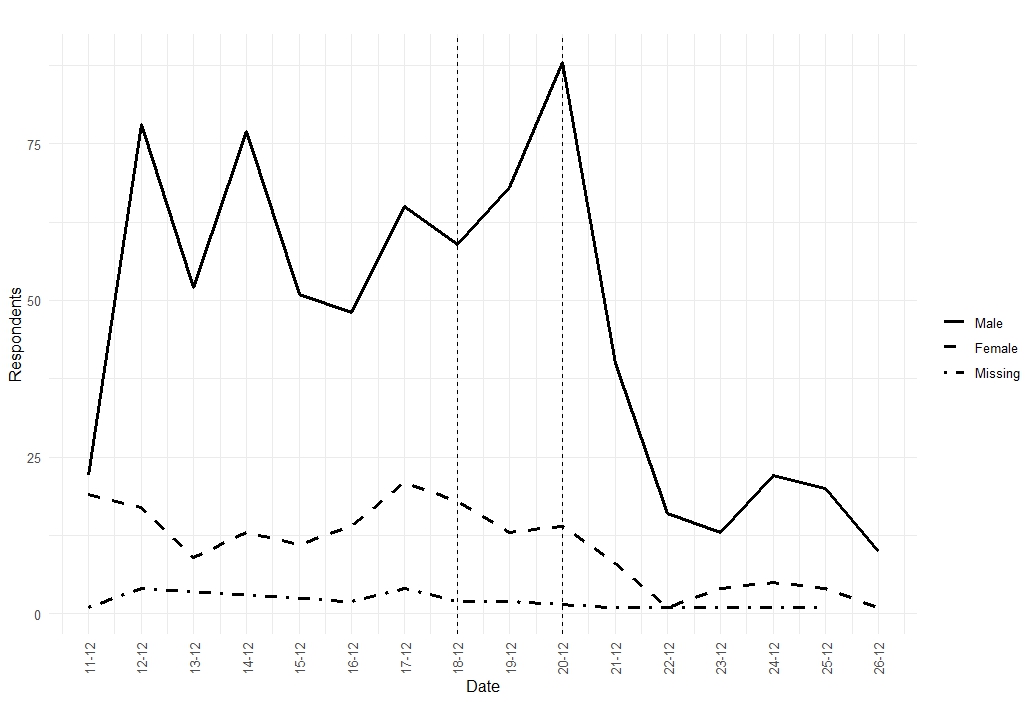
In response to this imbalance, several interventions were implemented during the field period. First, ad sets targeting male respondents in East Germany were deactivated, as this subgroup had already exceeded its quota by a substantial margin. At the same time, daily budgets for ad sets targeting women were increased, while budgets for the remaining male-targeted ad sets were reduced. Both changes happened on December 18 (see Figure 1). These changes were intended to counteract the gender imbalance by shifting advertising exposure toward female respondents. However, these adjustments did not produce the expected effect. Recruitment of male respondents continued at a high rate, while participation among women did not increase in response to higher budgets.
As the gender imbalance persisted, further interventions were undertaken. All remaining male-targeted ad sets were eventually deactivated, and budgets for female-targeted ad sets were increased again. These changes happened on December 20 (see Figure 1). Only after these measures did recruitment of male respondents decline noticeably. However, this decline was not accompanied by a corresponding increase in female participation. Instead, overall recruitment slowed down, indicating that reducing exposure to male audiences did not automatically translate into greater reach among female users.
.jpeg)
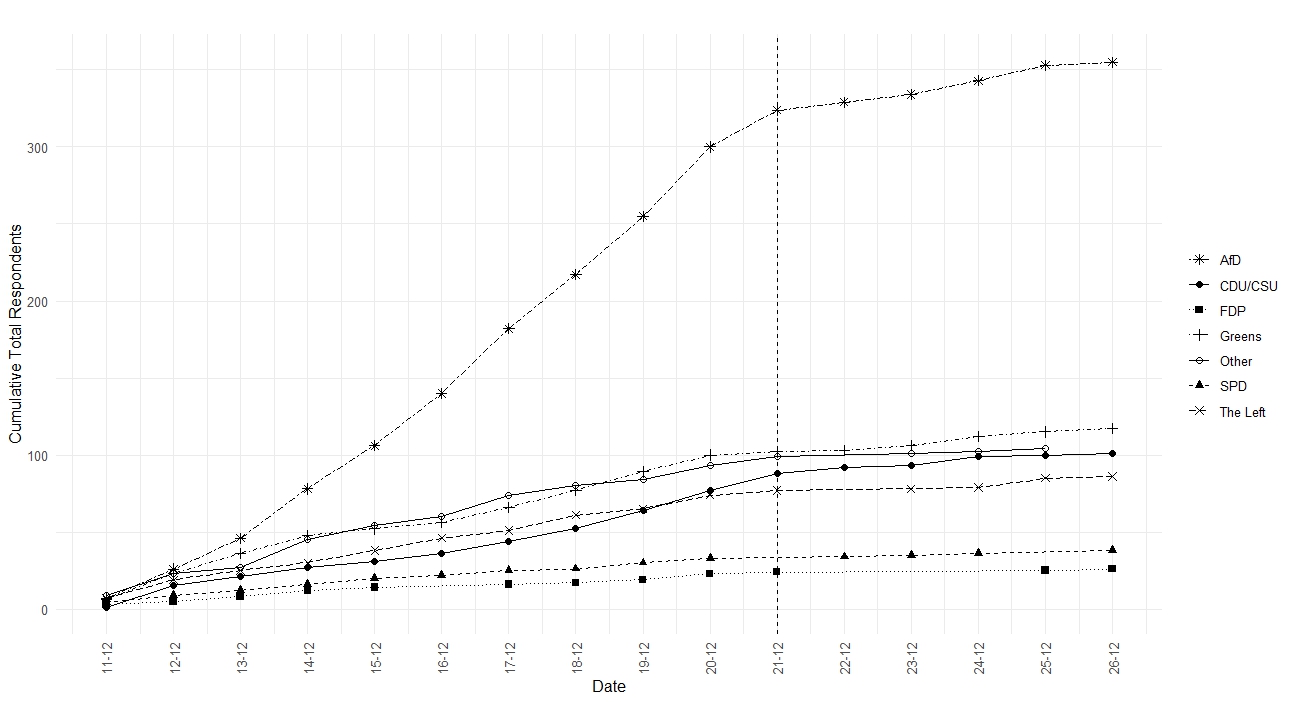
In parallel to quota monitoring, recruitment was also tracked with respect to substantive variables included in the survey. During the field period, it became apparent that a disproportionately high share of respondents reported support for the radical-right party Alternative für Deutschland (AfD). This pattern raised concerns that recruitment might be systematically biased with respect to political attitudes, potentially driven by the content and delivery of advertisements. To explore this possibility, the advertisement image that had recruited the highest number of respondents indicating support for the AfD was deactivated across all ad sets on December 21 (see Figure 2). This image corresponds to the politically framed version featuring a picture of the German Bundestag and the German flag (see Picture 3 in the Appendix).
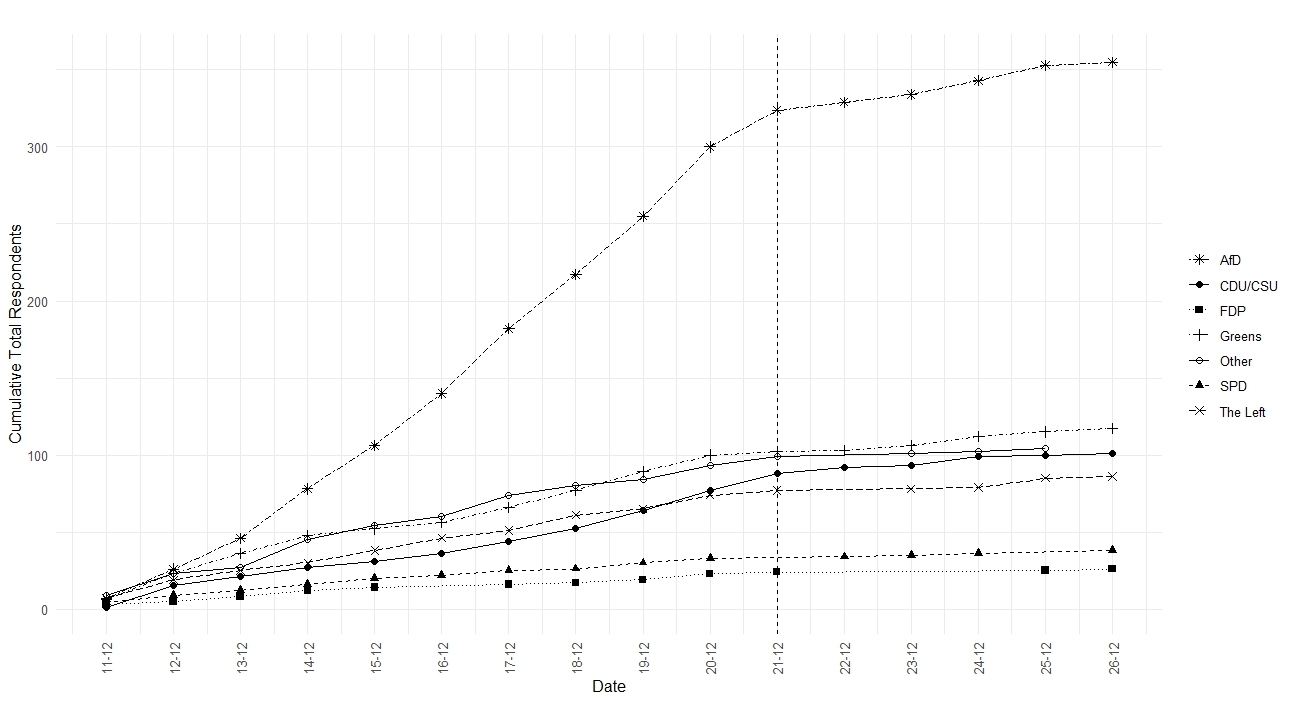
Contrary to expectations, this intervention did not lead to a reduction in the share of right-wing respondents in the sample. Instead, it resulted in a marked decline in overall recruitment. Participation rates dropped substantially following the removal of the most effective advertisement, suggesting that the advertising system had strongly prioritized this image in its delivery. Once removed, remaining advertisements were unable to compensate for the loss in reach and engagement.
Across interventions, a consistent pattern emerged: changes to budgets, targeting configurations, and advertisement content influenced recruitment volume but did not reliably improve alignment with predefined quotas. Attempts to correct imbalances through increased spending or selective deactivation of ad sets often reduced overall recruitment without producing the intended corrective effects. These observations indicate that recruitment outcomes were shaped not only by advertiser-defined settings but also by platform-specific delivery mechanisms that amplified early performance signals and constrained the effectiveness of later interventions.
In the end, a total of 2,674 interviews were realized. However, Table 1 only refers to those cases that fall into the targeted age group of 18–29 years and completed at least 50% of the questionnaire. A total of €1494.97 was spent as part of this campaign. This results in costs per interview of €1.63 if only considering those interviews that fall into the age group and have completed at least 50% of the questionnaire, while it results in a cost per interview of €0.56 if all interviews are included.
Taken together, field experiences demonstrate that quota-based recruitment via Instagram advertising was only partially controllable under real-world conditions. While monitoring and iterative adjustments allowed for responsive management of the campaign, deviations from targeted quotas—especially with respect to gender—proved difficult to correct once established. The following section draws on these experiences to distill practical lessons for survey practitioners considering social media advertising as a recruitment tool.
Practical lessons and takeaways for survey practitioners
The recruitment experience documented in this article highlights several practical lessons for survey practitioners using Instagram advertising for quota-based recruitment in non-probability samples.
Demographic targeting should be combined with very early and frequent field monitoring, starting within the first 1–2 days of the campaign and continuing on at least a daily basis. Given the rapid algorithmic optimization of ad delivery, imbalances can emerge quickly and become difficult to reverse once established.
Monitoring should be guided by pre-defined criteria and decision rules that reflect the study’s substantive goals. These may include acceptable deviation ranges from quota targets (e.g., ±10 percentage points) or thresholds for key variables. Decision rules can specify concrete actions, such as reducing budgets, pausing specific ad sets, or reallocating spending once thresholds are exceeded. For example, researchers may define in advance that if a subgroup exceeds a predefined deviation from its target share, targeted ad sets for this group are reduced or paused until balance is restored. Such rules should be tailored to the study but help ensure timely and consistent interventions.
Demographic targeting remains a useful starting point but should not be interpreted as ensuring proportional recruitment across groups. Some groups may be systematically overrepresented despite equal targeting, meaning that quota control often requires active intervention rather than relying on initial campaign settings.
Budget adjustments are most effective when used to manage overall recruitment dynamics rather than assuming that changes will translate proportionally into specific demographic groups or ad sets. Their effects are mediated by platform optimization processes and should therefore be applied as part of an iterative field management approach that combines monitoring with additional interventions such as activating or pausing ad sets.
Advertisement performance should be assessed multidimensionally. In addition to efficiency indicators such as cost per interview, practitioners should evaluate how different advertisements are associated with key survey variables. This is particularly important because engagement-driven delivery may amplify existing self-selection processes, leading to systematic differences in the composition of respondents. Where feasible, small-scale pretesting of advertisements or early-phase comparisons can help identify such patterns before they scale up.
Finally, monitoring can be strengthened by including a small set of theoretically relevant substantive indicators alongside demographic quotas. The choice of indicators should reflect the substantive focus of the study and can help detect biases that are not visible through demographic variables alone.
Conclusion
This article documented a quota-based recruitment campaign using Instagram advertising to recruit young adults in Germany and examined how recruitment unfolded under real-world field conditions. While social media advertising offers clear advantages in terms of reach and flexibility, quota-based recruitment via Instagram is only partially controllable in practice.
Despite continuous monitoring and iterative adjustments, substantial deviations from predefined quotas emerged—most notably with respect to gender—and proved difficult to correct, whereas age and regional distributions remained comparatively stable, indicating that quota dimensions may differ in how strongly they are shaped by algorithmic optimization. These patterns indicate that recruitment outcomes are shaped not only by advertiser-defined settings but also by platform-specific delivery mechanisms that amplify early performance signals.
However, this does not imply that Instagram-recruited survey data are inherently unsuitable for substantive research. Such recruitment may be well suited for studies examining associations, conducting embedded experiments, or focusing on hard-to-reach subpopulations, where internal validity and access may be more central than strict population representativeness. Meaningful use depends on aligning recruitment strategies with analytical goals, implementing predefined monitoring frameworks, and transparently documenting recruitment dynamics and interventions. When approached with realistic expectations and careful design, Instagram advertising can be a valuable sampling strategy.
Corresponding author contact information
Julia Weiß
GESIS – Leibniz-Institute for the Social Sciences
B6, 4-5
68519 Mannheim
Germany