Problem Description
Behavior change is influenced by a dynamic interplay of individual, interpersonal, and environmental factors. Yet evaluations of large-scale health communication campaigns often rely on quantitative methods to measure campaign impact, which may oversimplify the complex ways campaigns influence behavior (NORC at the University of Chicago 2023).
Launched in 2020, the Centers for Disease Control and Prevention’s (CDC’s) Hear Her campaign is a national health communication effort to help pregnant and postpartum women (PPW) and support people (SP; i.e., spouse, partner, family member, close friend) recognize urgent maternal warning signs (UMWS) and encourage them to either share concerns with a health care provider or immediately seek care (Behm et al. 2022; Centers for Disease Control and Prevention 2025). Campaign materials include a public website with videos featuring PPW who experienced UMWS, printable handouts and posters, and information on maternal mortality. Social media posts and PSAs expand the campaign’s reach.
In 2025, NORC at the University of Chicago partnered with CDC Foundation and CDC to conduct a pilot evaluation of Hear Her with two major challenges to solve. First, since Hear Her had been active for several years, a traditional pre-post design with a known baseline was not feasible. Individuals may have encountered the campaign through multiple avenues such as self-directed web use, social-media messaging, or clinic posters—none of which offered a standardized “dose” of exposure. Thus, exposure had to be carefully operationalized to meaningfully assess campaign effectiveness. Second, the team aimed to evaluate whether exposure to Hear Her materials influenced real-world behavior—specifically, whether PPW shared concerns or immediately sought care when experiencing symptoms. Cross-sectional surveys are poorly suited for evaluating behavior change because, by capturing data at one time point, they cannot determine whether campaign exposure influences behavior.
Solution
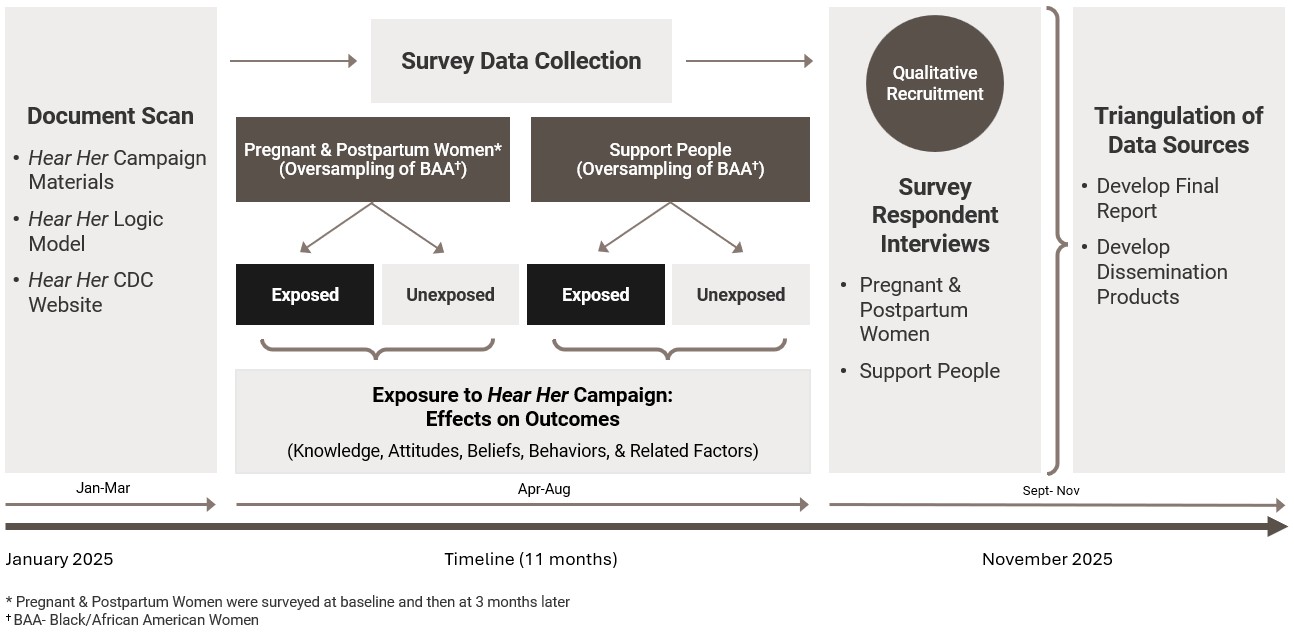
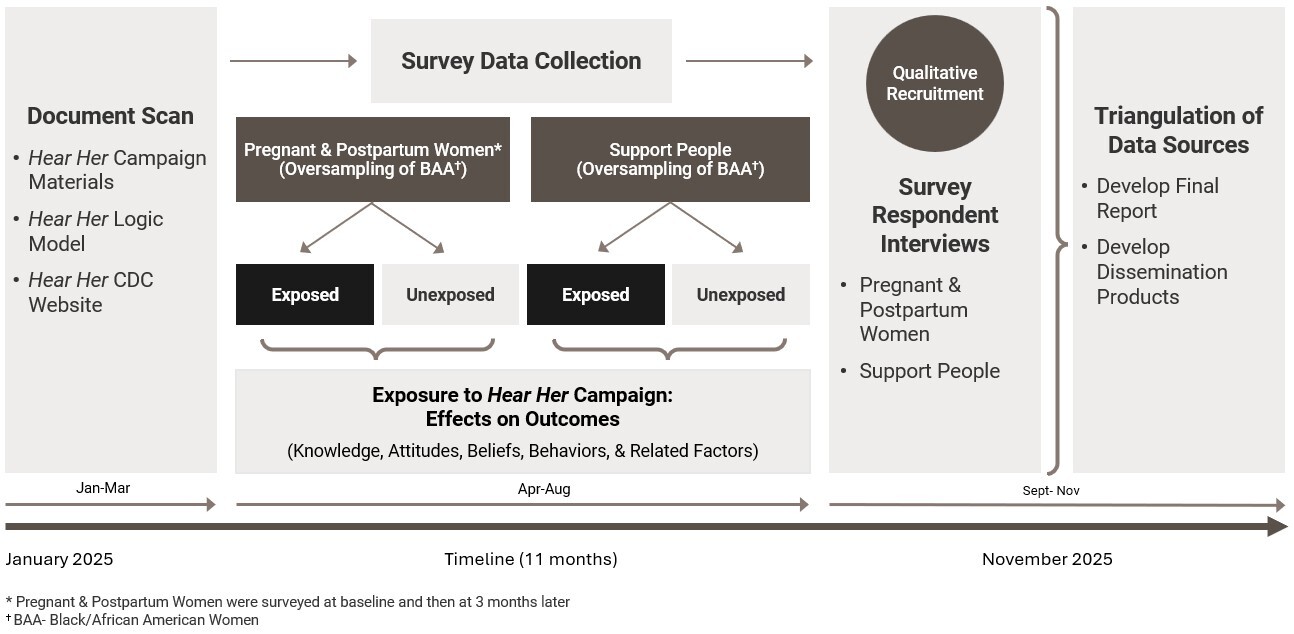
We conducted a pilot evaluation of Hear Her using a mixed-method quasi-experimental design, integrating quantitative and qualitative data (Figure 1). This pilot evaluation sought a comprehensive assessment of campaign effectiveness while exploring the feasibility of scaling the design for future evaluations. Using NORC’s AmeriSpeak panel (NORC at the University of Chicago 2024), the team recruited nationally representative probability samples of PPW and SP for surveys assessing awareness of UMWS and behavioral intentions after exposure to Hear Her materials. The team oversampled Black/African American PPW and SP to aid subgroup analyses. We surveyed PPW at two waves approximately 3 months apart. SP were surveyed once due to resource constraints. From these samples, the team purposively selected participants for individual interviews.
Addressing Challenge #1: Defining and operationalizing exposure in the absence of baseline data
The team implemented an aided recall protocol combined with randomization to create exposed and unexposed groups. Participants were asked if they had seen or heard of Hear Her or any campaigns with women discussing UMWS. These questions provided an indicator of prior campaign exposure. Participants who reported prior exposure were assigned to the experimental condition where they viewed campaign materials. Participants who reported no prior exposure were randomly assigned to either view campaign materials (exposed group) or not (unexposed group). Participants in the exposed group viewed four campaign materials in random order: a video, a social media post, a UMWS poster, and a conversation guide/palm card (see Supplemental Materials). These materials were purposively chosen because they were representative of core campaign messages while also being suitable length for viewing in the survey environment. Given that Hear Her was launched in 2020, individuals could have been exposed to campaign materials and messages prior to study enrollment. Therefore, our methodological approach reduced misclassification and increased the likelihood that the unexposed group had not previously encountered the campaign. Randomization ensured balance between exposed and unexposed groups on measured and unmeasured confounders and enabled us to attribute differences in outcomes to campaign exposure while accounting for pre-existing exposure in the population.
Addressing Challenge #2: Evaluating campaign impacts on behavior
The team’s longitudinal and mixed-method approach was critical to greater understanding of campaign impacts. PPW completed surveys at baseline assessing comfort in sharing concerns about worrisome symptoms and likelihood to seek immediate care if experiencing an UMWS. Follow-up surveys administered 3 months later reassessed comfort with sharing concerns and captured if PPW had experienced a worrisome symptom. This interval allowed for the possibility that a PPW might experience a UMWS, post-exposure. SP were asked about their comfort and likelihood to encourage PPW to share concerns or immediately seek care. The randomized exposure established causality between exposure to Hear Her and behavior change among participants because exposure preceded behavioral intentions or possible behavior outcomes.
Qualitative insights uncovered dimensions of influence not captured in the surveys. Interview participants were selected purposively from survey respondents in the intervention group to explore how and why exposure influenced their attitudes or behaviors. Interviews revealed PPW’s experiences with health care professionals, SP’s experiences providing a multitude of support for PPW, and PPW and SP reactions to Hear Her materials. These insights required deeper probing than a survey could provide. This approach provided a separate, complementary line of inquiry to understand campaign effectiveness.
Triangulating quantitative and qualitative data increased confidence in the findings. Interview data added context to findings from the survey. For example, survey data showed that PPW exposed to Hear Her were more likely than those not exposed to report experiencing an UMWS in the follow-up survey. In interviews, a couple of respondents explained that they shared their concerns with a health care professional because of information they saw in the materials. As another example, survey data showed SP with higher educational attainment were likely to encourage the woman they support to seek care for almost all UMWS. The interview data found that some SP had previous education or professional training in health care, which provided important context for the educational subgroup differences observed in the survey.
Through analysis of survey data, the team inferred campaign impacts on behavior at scale. Through interviews, the team identified self-reported behavior change as a result of exposure to materials, particularly among PPW who experienced worrisome symptoms. By comparing and cross-checking findings from the two methods, we found numerous consistencies which together could be merged to tell a richer story about campaign impact and identify opportunities for future campaign improvement.
Effectiveness of the solution
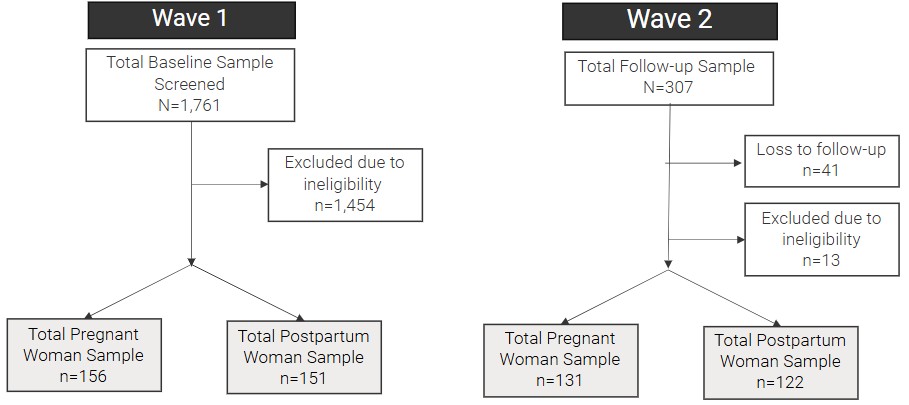
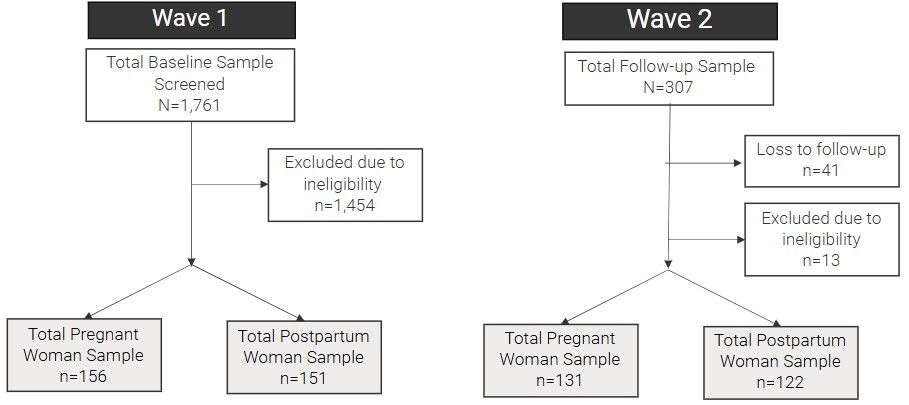
Overall, the pilot evaluation design offered a rigorous and contextually rich solution to the methodological challenges of assessing the effectiveness of a national health communication campaign. The final baseline sample included 307 PPW and 324 SP, which exceeded recruitment goals and was 80% powered to detect small effects. The evaluation achieved high retention rates at follow-up among PPW (Figure 2), with retention rates of 84% (pregnant women) and 81% (postpartum women). Statistical analyses showed no statistically significant differences in retention by pregnancy status, exposure group, or race. Due to the high percentage of PPW (50%) and SP (52%) that agreed to an interview, the team could maximize variability in participant demographics and characteristics when selecting interview participants. The pilot evaluation design demonstrated validity through strong recruitment and retention. Recruitment achieved the target overall sample size and the desired oversample of Black/African American women, thus enabling adequately powered subgroup analyses for a population disproportionately impacted by maternal morbidity and mortality. Low retention can introduce selection bias, such that highly motivated individuals are more likely to respond, reducing confidence that observed differences are attributable to campaign effects rather than self-selection. In this study, high retention mitigated this risk and increased confidence in the findings.
Recommendations for future work
Given our experience, we offer two recommendations for future evaluations of national health communications campaigns. First, future evaluations conducted with groups characterized by high levels of heterogeneity, such as SP, may benefit from a more extensive and strategically targeted qualitative component. Additional qualitative interviews could have provided deeper insight into how campaign messages are interpreted and acted upon across different types and roles of SP, including potential differences between those supporting pregnant versus postpartum women. Second, future evaluations may benefit from incorporating secondary data sources, such as the Pregnancy Risk Assessment Monitoring System (PRAMS), during the interpretation phase to situate findings within broader population-level trends. While such data are unlikely to align perfectly with campaign exposure timing or measures, they can provide useful contextual benchmarks for understanding the prevalence of symptoms, care-seeking behaviors, or trends observed in campaign evaluation data.
Conclusion
This mixed-method quasi-experimental pilot evaluation design successfully addressed two major practical challenges in evaluating national health communication campaigns: defining exposure and capturing behavioral impact without baseline data. It provided breadth and depth in understanding the complex, intersecting factors that link campaign exposure to behavior change within a dynamic information environment. By triangulating quantitative and qualitative data, the evaluation captured measurable outcomes and contextual insights, yielding findings representative of the target populations and informed by lived experience. The thoughtful integration of quantitative and qualitative methods is paramount for evaluating large-scale public health campaigns and generating actionable evidence for future communication efforts.
Acknowledgements
The source of this information is the public-private partnership, ‘Hear Her Evaluation and Support for Enhanced Partnerships and Dissemination,’ a joint project of the CDC Foundation and Merck for Mothers with technical support from the Centers for Disease Control and Prevention.
Funding
This project was supported by the Centers for Disease Control and Prevention (CDC) of the U.S. Department of Health and Human Services (HHS) as part of a financial assistance award totaling $125,000 (33%) funded by CDC/HHS and $255,000 (67%) funded by non-government source(s). The contents are those of the author(s) and do not necessarily represent the official views of, nor an endorsement by, CDC/HHS, the U.S. Government, or the CDC Foundation.
Corresponding author contact information
Naomi K. Greene, Ph.D., MPH
Public Health Department
NORC at the University of Chicago
1828 L Street NW, 9th Floor
Washington, D.C. 20036, USA
Email: greene-naomi@norc.org