INTRODUCTION
While research has consistently demonstrated the positive association between social support and health-related quality of life among non-Hispanic White (NHW) cancer survivors, few studies explore how cultural factors influence these outcomes in diverse Asian American (AA) populations (Costas-Muñiz et al. 2017; Culbertson et al. 2020; Forsythe et al. 2014; Gudina et al. 2021; Hurtado-de-Mendoza et al. 2022; Leow et al. 2021; Samuel et al. 2020; Vang 2023; Westby et al. 2016; Yoon et al. 2016; Zhai et al. 2019). The predominant use of standardized scales in assessing quality of life raises concerns about cross-cultural validity, as previous studies report unexplained differences in how AA populations perform on these measures (Im et al. 2023; Pagano and Gotay 2005). This gap perpetuates a one-size-fits-all approach to cancer survivorship research, failing to account for unique cultural contexts and lived experiences.
The model minority myth has hindered progress in understanding the unique challenges encountered by AA populations in seeking cancer care services (Kim et al. 2021). While the movement to disaggregate data and conduct research on specific AA subgroups has been crucial over the last two decades (Bhakta 2022; Chen Jr et al. 2022; Holland and Palaniappan 2012; Lee et al. 2024; Nguyen et al. 2022; Sabado-Liwag et al. 2024), there remains a dearth of data on cultural differences and lived experiences of made-to-be-vulnerable population subgroups such as Chinese, Japanese, and Vietnamese breast cancer survivors. Made-to-be-vulnerable groups are populations whose susceptibility to harm is produced through systemic inequities and structural barriers, such as social, political, and economic forces that actively create conditions of vulnerability, rather than through inherent characteristics at the individual level (Clark and Preto 2018; Garrett and Altman 2024; Munari et al. 2021). A workshop reviewing disparities in research with AAs found that data disaggregation is essential and that approaches should involve collaborations with community partners when identifying needed resources and developing intervention programs (Kanaya et al. 2022). Another scoping review about best practices for overcoming challenges when identifying made-to-be-vulnerable populations found that language proficiency was a factor and that data collection in languages other than English was lacking (Shimkhada et al. 2021).
This article articulates lessons learned when identifying and recruiting made-to-be-vulnerable and underserved groups using a convergent mixed-methods design (Fetters et al. 2013; Guetterman et al. 2015) across three geographic regions and three AA communities. The intent is to provide practical methodological guidance for researchers working with hard-to-reach populations.
METHODS
Study Design
This 5-year cross-sectional study (2011-2016) applied a population-based convergent mixed-method (quantitative and qualitative) and mixed-paradigm (deductive and inductive) design to capture culturally nuanced differences in coping with cancer among NHW and AA (Chinese, Japanese, and Vietnamese) women diagnosed with breast cancer. The study was conducted in partnership with community-based organizations: the Chinatown Public Health Center in the Greater San Francisco Bay Area, Herald Cancer Association in Los Angeles County, Vietnamese American Cancer Foundation in Orange County, and Asian American Health Coalition in Houston, Texas.
The research questions and specific aims were:
-
How do support services for AA breast cancer survivors differ conceptually and functionally with mainstream support services? (Primarily informed with inductive data)
-
Aim 1: To explore how perceptions of quality of life may differ by women in each of the four ethnic groups.
-
Aim 2: To identify if and how ethnic specific support services address the culturally informed expectations of self-integrity and well-being of AA breast cancer survivors, and how this may differ by ethnic group.
-
Aim 3: To explore if cultural differences exist in how partners and adult children of AA breast cancer survivors provide support compared to NHW partners and children.
-
-
Do the differences identified explain the variations in standardized quality of life measures?
- Aim 4: Identify the impact of the cancer experience on their quality of life, and assess if the cultural impact differs by ethnicity. (Primarily informed with deductive data)
The convergent design involved simultaneous collection of data through individual interviews, focus groups, and survey completion. Preliminary findings from focus groups with cancer survivors and key informant interviews informed semi-structured interview questions for subsequent interviews with breast cancer survivors and their family members/friends, and use of standardized and non-standardized measures. Data were then merged and compared during analysis.
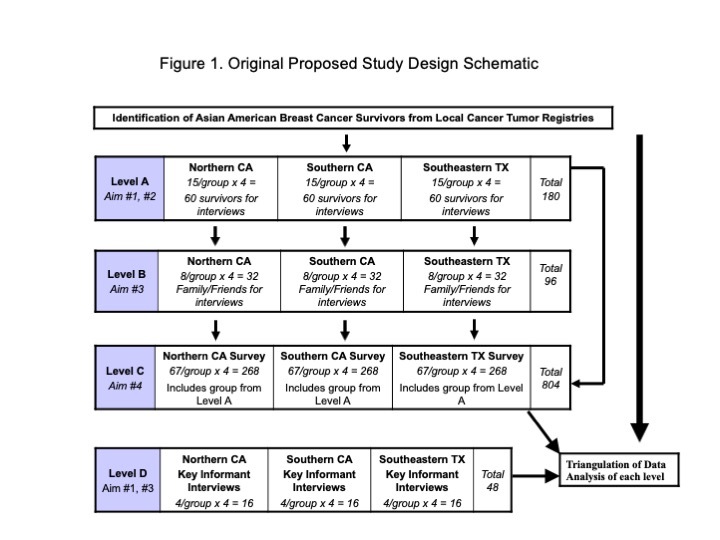
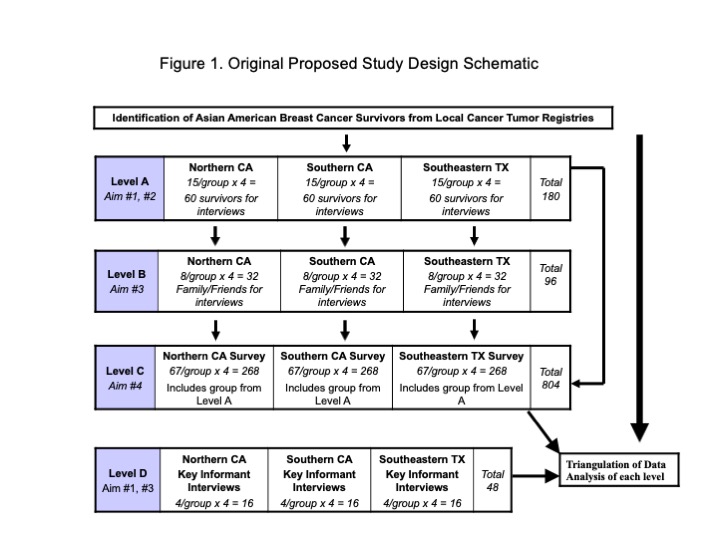
The original approach (see Figure 1) included a multi-level data collection process with qualitative techniques (individual interviews and focus groups) with three types of individuals (breast cancer survivors, family members/friends, and community leaders/key informants), and quantitative methods (surveys) with cancer survivors only. Initial intent was to work closely with community agencies to conduct awareness campaigns prior to distributing study invitation letters to eligible survivors identified through tumor registries, followed by nested recruitment. However, significant adaptations to the design were required based on reductions in the proposed funds at time of award, and recruitment challenges encountered.
Participants
Three categories of participants were recruited:
-
Breast cancer survivors (BCS) who self-identified as Chinese, Japanese, or Vietnamese; were 35-75 years of age; were within 1-5 years of diagnosis; could be interviewed in Chinese (Cantonese or Mandarin), Vietnamese, or English; and were willing to identify a family member or close friend to be interviewed. (Figure 1, Levels A & C)
-
Family members or friends (FF) who self-identified as a family member or close friend of the survivor; were any gender; and were over 18 years of age. (Figure 1, Level B)
-
Key informants or community leaders (KI) who self-identified as one of the three AA ethnic groups; had worked for at least 5 years in the cancer control field with women who have had breast cancer; had lived in the U.S. for at least 10 years; and were willing to be interviewed in English. (Figure 1, Level D)
Study Materials and Translation
Two survey packets assessed social support constructs and health-related quality of life using standardized measures. Packet 1 contained 89 items that assessed demographic data (i.e., ethnicity, religion, marital status, education, etc.), type of cancer treatment received, constructs of social support received (i.e., functional, tangible, emotional), and perspectives about femininity and sexuality. Packet 2 consisted of 15 standardized measures and 232 items that assessed health-related quality of life, physical health and psychological health. Interview guides for each participant type explored reactions to cancer diagnosis, decision-making processes, resources accessed, and cultural perspectives on support and survivorship.
Translation of recruitment flyers, survey packets, interview guides, and invitation letters (18 documents total) involved a multi-step process with bilingual and bicultural individuals from community partners. Forward-translation from English to the ethnic language (Chinese and Vietnamese) and back-translation to English tested for conceptual equivalence. Study materials were not translated into Japanese due to the long-standing Japanese immigration history into the United States, guidance from the study investigators, and the experience of community partners working with this community. This process was completed in 5 months.
Three invitation letters were developed: a physician letter describing the study purpose and requesting identification of any patients who should not be contacted; an interview/focus group and survey letter for comprehensive study participation; and a survey-only letter with both English and in-language versions of survey packets.
Recruitment Process
Three Institutional Review Board (IRB) approvals were obtained – the primary research institution and two tumor registries. Initial identification of BCS from all four ethnic groups used contact lists from the California Cancer Registry (CCR) and Texas Cancer Registry (TCR). A community-informed decision was made to transition to purposive and snowball sampling at each regional site once contact lists were exhausted. Leveraging community-based organizational networks and focusing on specific demographics and clinical characteristics, BCS were invited (by phone or in-person) by trained study representatives from partner organizations. Snowball approaches occurred at the end of BCS interviews – using an invitation packet to be given to FF or other BCS willing to participate in the study – and through mailed letters to BCS who completed the survey packets. The invitation packet included a letter describing the study and a postage-paid ‘consent to be contacted’ card that interested participants can mail back. Mailed appreciation letters included the gift card incentive for the completed packets and a study flyer to be shared with a BCS.
Monthly meetings with community organization directors provided insight on best approaches for outreach within each AA subgroup and identified bicultural and bilingual staff to assist with recruitment. All research team members received human subjects protection training and guidance on protocols for confirming eligibility, tracking participants, administering interviews, and conducting follow-up.
Letters to physicians were sent first by the primary research institution, followed by invitation letters to eligible BCS printed on community agency stationary. Mailings were conducted in “waves” (30-60 letters every 4 weeks) to avoid exhausting limited case listings. Initial waves invited participation in interviews/focus groups and survey completion. Subsequent waves targeted survey-only participants once interview and focus group sample sizes (by subgroup and by geographic site) were achieved.
Family members/friends were identified by BCS participants who provided them with study information and consent cards. Key informants were identified through the research team’s network and community partnerships.
Data Collection Procedures
Focus groups were held in-person at community agencies with two research team members moderating. Individual interviews were conducted using different modalities based on their geographic accessibility – either in-person at locations identified by participants, or by phone or video (i.e., Skype) if they were remote and unreachable by the research team. Focus group and interview participants were compensated with a $50 gift card. Both approaches used the preferred language and semi-structured interview guides with 25-30 questions. All sessions were audio recorded and transcribed verbatim. Those conducted in-language were first transcribed into the Asian language, then translated into English by bilingual and bicultural members of the research team.
Survey packets (English, Chinese or Vietnamese versions) were mailed in waves with 2-week completion timeframes for each packet ($2 postage cost per packet). Follow-up calls determined receipt, assessed interest, and clarified questions. Upon receipt of completed Packet 1, it was reviewed for completeness – with follow-up calls to address any questions or concerns and to ensure data quality – before mailing Packet 2. Participants received a $40 gift card after returning both packets.
RESULTS
After four years of active outreach and recruitment, 405 survey packets (Completed Packets 1 and 2) were collected from BCS and 212 interviews and focus groups (36 KI, 119 BCS, and 57 FF) were collectively conducted across three sites. Using tumor registries and community-based participatory approaches, 138 Chinese, 101 Japanese, 70 Vietnamese, and 96 NHW BCS were recruited from Northern California, Southern California, and Southeastern Texas.
Tumor Registry Challenges
Approval and receipt of case listings from CCR was received at the end of Year 3 (January 2014) while case listings from TCR were received in Year 4 (September 2014). Multiple simultaneous requests for case listings involving AA women with breast cancer resulted in extremely low numbers of eligible patient data from the tumor registries since case assignments were restricted to one study.
For TCR, legal and administrative issues placed the application on hold for two years. Required submission of translated questionnaires and human subjects assurances from all individuals accessing TCR data delayed the application another 9 months, resulting in a 3-year approval process.
Recruitment Outcomes
Study enrollment for KI began in Year 2, with 36 interviews completed between September 2012 and July 2013. Enrollment for BCS and FF groups began in Year 3. Since tumor registry data were limited and receipt of contact lists was 9 months apart, outreach involved purposive and snowball sampling techniques using community partners’ program lists and word-of-mouth through study participants who completed interviews/focus group or survey packets.
The number of interested and eligible participants dwindled after the initial recruitment period, especially within Japanese and Vietnamese communities. After exhausting initial tumor registry contact lists, renewed efforts included attendance at community events, radio/public service announcements, and direct contact with organizations working with the Asian communities of focus.
A total of eight focus groups was completed (target was nine). In Southeastern Texas, only thirteen Japanese American women were identified through TCR (all unresponsive to the invitations) and no ethnic-specific agencies represented Japanese Americans, making it impossible to conduct a Japanese focus group. Houston lacked the community infrastructure to provide resources to Japanese community members, making it difficult to establish necessary trust.
As noted in Table 1, individual BCS interviews exceeded targets in some areas to compensate for Texas recruitment challenges. A total of 1170 BCS were contacted across all sites and subgroups, nearly double the original target sample size (n=660).
-
Completion rates among contacted participants: Of the 1170 BCS contacted, 430 participants completed Packet 1 (36.8% completion rate), while 405 participants completed both Packets 1 and 2 (34.6% completion rate), representing a 5.8% attrition rate between packets.
-
Achievement of target sample sizes: The 430 Packet 1 completions represent 65.2% of the original target (430/660), while the 405 who completed both packets represented 61.4% of the target (405/660). Due to over-sampling for certain subgroups by site, 119 interviews and focus groups were conducted with BCS, two more than the 117 target (101.7% of target). A total of 57 of 72 interviews (79.2% of the target) were conducted with FF.
DISCUSSION
The primary objective of this multi-site study was to explore cross-cultural differences in quality of life between NHWs and three AA subgroups using standardized scales and qualitative data. The multi-faceted data collection approaches resulted in successful compilation of a large dataset, but the process encountered significant challenges. The lessons learned point to the critical importance of working in partnership with community agencies to build trust when recruiting participants from made-to-be-vulnerable populations rather than solely relying on tumor registry case listings. Although this study was conducted over 10 years ago, many of the recommendations associated with enhancing community engagement and being culturally responsive to the needs of diverse populations remain relevant and attainable. In fact, recent shifts toward virtual engagement and digital outreach platforms (i.e., email newsletters and social media) may enhance the feasibility of some approaches, such as the use of phone and video interviews, which were novel at the time of this study but have now become a more common practice in the research landscape.
Lesson 1: Allow Extended Timelines for Tumor Registry Access
Use of tumor registry data provided a starting point to recruit diverse participants from each ethnic group. However, the registry application process was not streamlined and contributed to substantial delays. Researchers and clinicians who intend to use similar medical registry data for recruitment should add a minimum of 6 months to their timeline and should have all study materials ready when submitting their data request given potential variabilities in processes and access requirements. Multiple competing requests for tumor registry data resulted in small case listings of potential AA participants in California, and even smaller numbers in Texas due to modest AA populations in Houston and surrounding counties.
Lesson 2: Prioritize Community Partnerships Over Cold Mailings
As advised by community partners, the research team learned that AAs are not receptive to cold mailings. BCS who do not speak English would have likely disregarded packets due to the size of mailers and lack of knowledge about the originating institution. Strategies to overcome this challenge involved consistent communication with community partners about best practices for connecting with members of each AA subgroup and increasing study visibility.
Successful approaches that improved recruitment included
-
Outreach at local festivals during periods of ethnic holidays
-
Outreach through faith-based groups
-
Use of local ethnic media (newspaper ads, radio announcements, television spotlights)
-
Featuring testimonials from ethnic-specific BCS willing to share their experiences
-
Use of in-language materials
The use of trusted local ethnic media, before waves of invitation and survey packets were mailed, was cost-effective at increasing awareness about the study, the institutions involved, and the potential community contributions made through participation (especially among groups/sites with less access to community resources). Additionally, there was less likelihood of expensive packets being ignored or left unopened. Due to stigma often associated with cancer diagnosis, hearing about cancer experiences from ethnic-specific BCS was important to survivors’ self-efficacy to overcome challenges and negative perceptions accompanying a cancer diagnosis.
Moving forward, incorporating contemporary forms of outreach, such as emailed newsletters through community organizations and postings on social media platforms (i.e., Instagram, Facebook, TikTok) has the potential to increase study visibility and expand connections with made-to-be vulnerable groups.
Lesson 3: Build Flexibility into Eligibility Criteria
Low response rates from mailings required expansion of eligibility requirements. Adaptive modifications included:
-
Increasing age limit from 35-70 to 35-75 years
-
Allowing women who self-identified as “half” of a particular ethnicity to participate
-
Expanding geographic radius beyond original study sites (San Francisco Bay Area expanded to San Jose, Berkeley, Oakland, and Sacramento; Greater Houston Area expanded to additional counties)
Individuals with dual ethnicities were asked to indicate which ethnic subgroup they identified with most and were placed in that group for participation.
Lesson 4: Account for Regional Infrastructure Differences
Significant variation existed in community infrastructure across sites. Houston’s lack of Japanese American community organizations made it impossible to establish trust necessary to recruit Japanese survivors, despite identifying eligible individuals through the tumor registry. Researchers conducting multi-site studies with diverse populations must assess community infrastructure capacity during planning phases and adjust recruitment strategies accordingly.
Lesson 5: Cultural Competence Requires Ongoing Community Dialogue
Monthly meetings with community organization directors throughout the study period provided essential guidance on culturally appropriate recruitment approaches. These partnerships allowed the research team to:
-
Modify study materials to reflect cultural preferences
-
Identify trusted community leaders to serve as research team members
-
Navigate cultural sensitivities around cancer stigma
-
Adapt outreach strategies based on ethnic-specific communication patterns
The community-based participatory approach was not simply a recruitment strategy but an essential methodological component that shaped data collection processes.
CONCLUSIONS
Although the number of individuals living after a cancer diagnosis is rising, greater understanding of how to address and reduce ethnic disparities in breast cancer care, especially among diverse AA subgroups, is needed at all phases of the cancer care continuum. This study provides evidence that employing a convergent mixed-methods approach to recruit hard-to-reach groups such as Chinese, Japanese, and Vietnamese BCS was effective in collecting a sizable dataset despite significant recruitment challenges. While this study was conducted between 2011-2016, these methodological lessons remain highly relevant. Application of contemporary technological advances may enhance the feasibility of some recommendations, while the core principles of community partnership and cultural responsiveness remain as essential as ever.
Key recommendations for researchers planning similar studies
-
Timeline planning: Add minimum 6 months for medical registry applications; anticipate 3+ years for complex multi-state approvals
-
Community engagement: Establish partnerships early and maintain ongoing dialogue throughout recruitment
-
Cultural responsiveness: Prioritize ethnic-specific media (traditional and contemporary) and community events over cold mailings to increase study awareness
-
Flexibility: Build adaptive capacity into eligibility criteria and geographic reach
-
Infrastructure assessment: Evaluate community organization capacity across sites during planning phases
The methods applied in this study demonstrate that with appropriate community partnerships, adaptive recruitment strategies, and cultural responsiveness, researchers can successfully implement convergent mixed-methods designs with hard-to-reach populations. These approaches move beyond traditional registry-based recruitment to engage made-to-be vulnerable communities in ways that respect cultural contexts while maintaining methodological rigor. The resulting datasets enable identification of cross-cultural differences in perceived quality of life and access to social support, contributing to more equitable cancer care.
ACKNOWLEDGEMENTS
Thank you to the members of the community advisory group who provided input and feedback at several points throughout the study. Thank you to the biostatisticians from the UCLA Center for Health Policy Research for their guidance and assistance with the initial analyses. The authors also wish to acknowledge Ashley Slight, Taeko Yoshizaki, Audrey Doan, Duyen Tran, Hannah Nguyen, Jeremy Ramirez, Paul Chandanabhumma, James Huynh, and the countless interns who participated in the development of the study materials, recruitment efforts, interviews, and data management. More importantly, the authors wish to extend their gratitude to the study participants who willingly shared their cancer experiences and stories of survivorship.
FUNDING
This study was funded by the National Cancer Institute (Award #1R01CA158314-01), May 2011 to April 2016.
CORRESPONDING AUTHOR CONTACT INFORMATION
Annalyn Valdez-Dadia, DrPH, MPH
Department of Human Services
College of Health, Human Services and Nursing
California State University, Dominguez Hills
1000 E. Victoria Street, SBS D-328
Carson, California 90747
(310) 243-2411
avaldezdadia@csudh.edu