1. Introduction
Despite the prevailing bourgeois family norm of two married, heterosexual, cisgender parents sharing a household and being biogenetically related to their children, family structures have always been changing. Currently, more and more people live in complex (patchwork) constellations, co-habit with chosen families, raise children as solo parents, or take part in co-parenting outside of romantic relationships (Fischer and de Vries 2023; Schneider and Kreyenfeld 2021; Teschlade et al. 2025). Thus, who belongs to one’s family is often a matter of perspective (Fish et al. 2024).
These developments challenge the design of traditional family and household surveys that rely on the household as the primary unit of analysis (Bartova et al. 2025). Surveys that remain anchored in cis-heteronormative, nuclear family models systematically fail to account for the lived realities of diverse family structures. In contrast, surveys addressing the queer community, such as the Swiss LGBTIQ+ Panel (Eisner and Hässler 2025), adopt more inclusive frameworks but are limited by a small sample size with respect to family-related data.
In this article, we show the advantages of the ‘sandwich method’ (Sandelowski 2000, 248), whereby findings from prior qualitative interviews inform the design of a survey, which in turn guides subsequent (follow-up) interviews and participatory qualitative approaches. Specifically, we illustrate how earlier qualitative research informed the design of the survey Queer Families in Switzerland[1] to capture complex family constellations. Our goal is to design-in queer lives and reduce normativity while ensuring connectivity to previous research. The next section describes a co-parenting constellation that was interviewed in qualitative research. We then show how this constellation can be meaningfully and comprehensively captured in a quantitative survey. Following the structure of the survey, we start with the respondents, move on to the children, and then to the parenting constellation. We conclude with broader implications for the design of inclusive family surveys.
2. Complex Family Relations
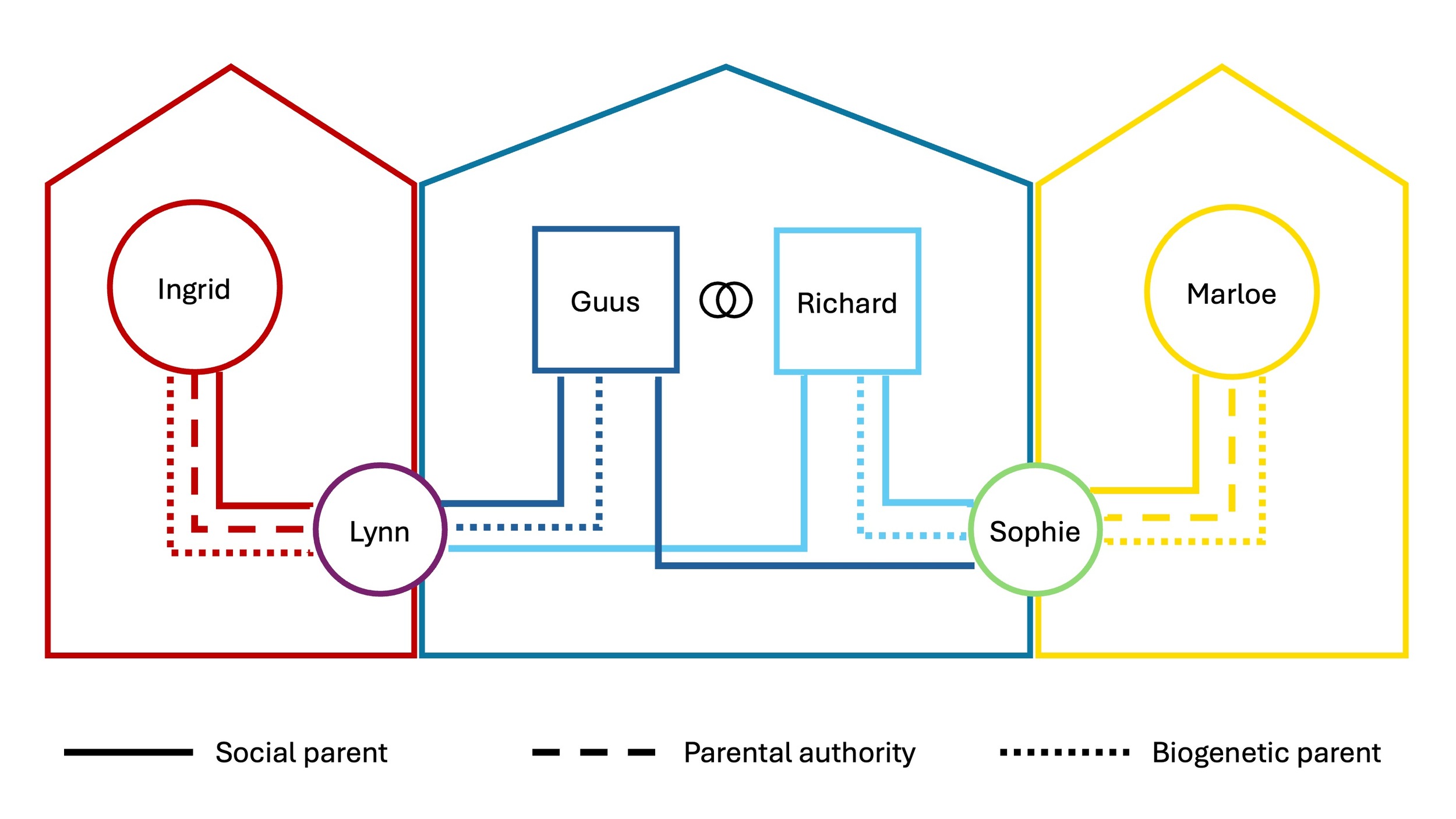
Before developing the survey, Ammann conducted in-depth, biographical, narrative interviews with 43 gay, bisexual, trans, and non-binary parents, including four couples, in Switzerland and the Netherlands. The interviews lasted between 66 and 194 minutes. In line with research participants’ preferences, the interviews occurred in their homes (n=17), coffee shops (n=8), during long walks (n=9), or online (n=9). Ammann also carried out follow-up interviews with five research participants and took part in four pre-existing monthly group meetings with gay fathers, contributing questions and occasional facilitation but without leading the discussions (total n=14) (Ammann 2025a, 2025b; Ammann and Miller 2025). The insights revealed the complexity of queer family constellations, extending well beyond the nuclear family norms. Consider one Dutch family from her research displayed in Figure 1: Guus (pseudonym), a cisgender gay man, cohabits with his partner Richard. Guus is the biogenetic father of their daughter, Lynn, and a (non-biogenetic) father of their daughter, Sophie. Lynn resides primarily with her mother, Ingrid, spending two days every second week with Guus and Richard. Ingrid regards Guus alone as Lynn’s father, whereas Richard identifies as Lynn’s father, given his involvement in her upbringing from birth, and Lynn herself has variably described having one or two fathers. Sophie, whose biogenetic father is Richard, divides her time nearly equally between her two homes, transitioning three times weekly between her mother, Marloes, and her fathers. Despite each father’s legal recognition as a biogenetic parent, neither holds parental authority, with decisions made by the mothers.
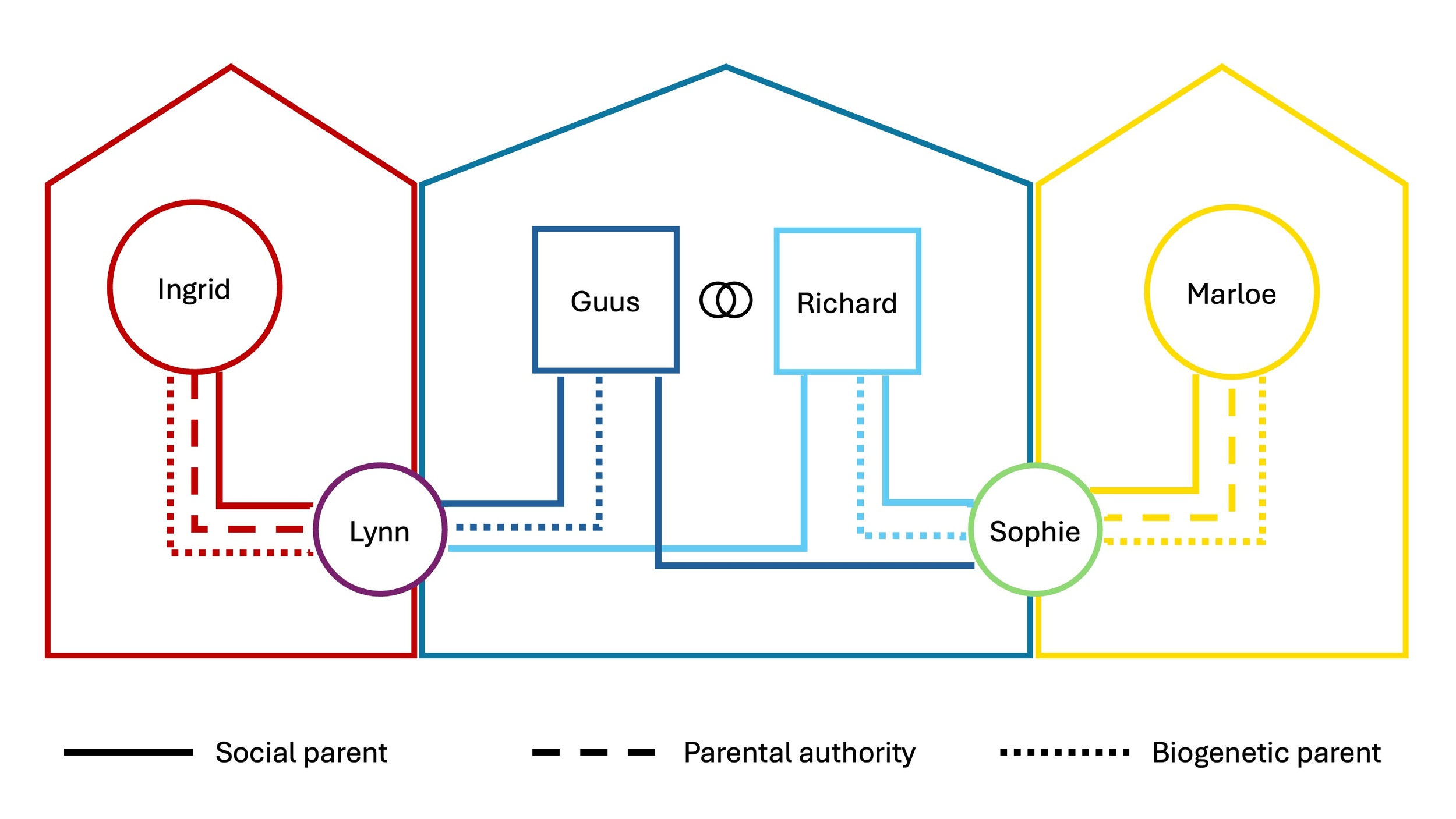
Table 1 shows that conventional family and household surveys often fail to capture such complex family configurations. In Ingrid’s case, for instance, the survey would register only a single mother with her daughter, implicitly presuming separation or divorce from the child’s father. The same applies to Marloes’s household, despite Sophie spending nearly half her time with Guus and Richard. Would Guus and Richard report both daughters as part of their household, or exclude Lynn, who primarily resides with Ingrid? Limiting classification to the mothers’ households would, in this case, prevent these families from being identified as queer. Conceptions of family membership thus differ, depending on whether Guus, Richard, Ingrid, or Marloes is asked, leading to systematic exclusion of numerous complex constellations from official statistics and research (Guyan 2022). This may be due to inadequate survey design or respondents’ reluctance to participate when their realities are not represented. This applies not only to queer families, but to all family constellations that go beyond the nuclear family model, for example, patchwork-families, heterosexual parents living apart together, multi-generational families, or co-parented families.
The interviews underscored the necessity of integrating complex family configurations into our survey—showing the importance of using a mixed-method approach for family studies (Plano Clark et al. 2008) and of queering the mixed-method approach (Shannon-Baker 2025). They also revealed that key topics—such as gender identity or different pathways to parenthood—are frequently overlooked in surveys predicated on a default nuclear family model. Our survey design therefore, incorporated targeted questions on how queer individuals become parents, navigate legal recognition, and negotiate caregiving responsibilities. Beyond drawing on insights gained from the prior qualitative research to develop items addressing under-researched areas, we also adapted and expanded established themes from prior studies on families and LGBTQIA+ individuals to enhance comparability (Bundesamt für Statistik (BFS) 2024; Dachverband Regenbogenfamilien Schweiz 2017; Eisner and Hässler 2025; Meuwly et al. 2024; Zindel et al. 2023).
3. Centring the Respondent’s Perspective
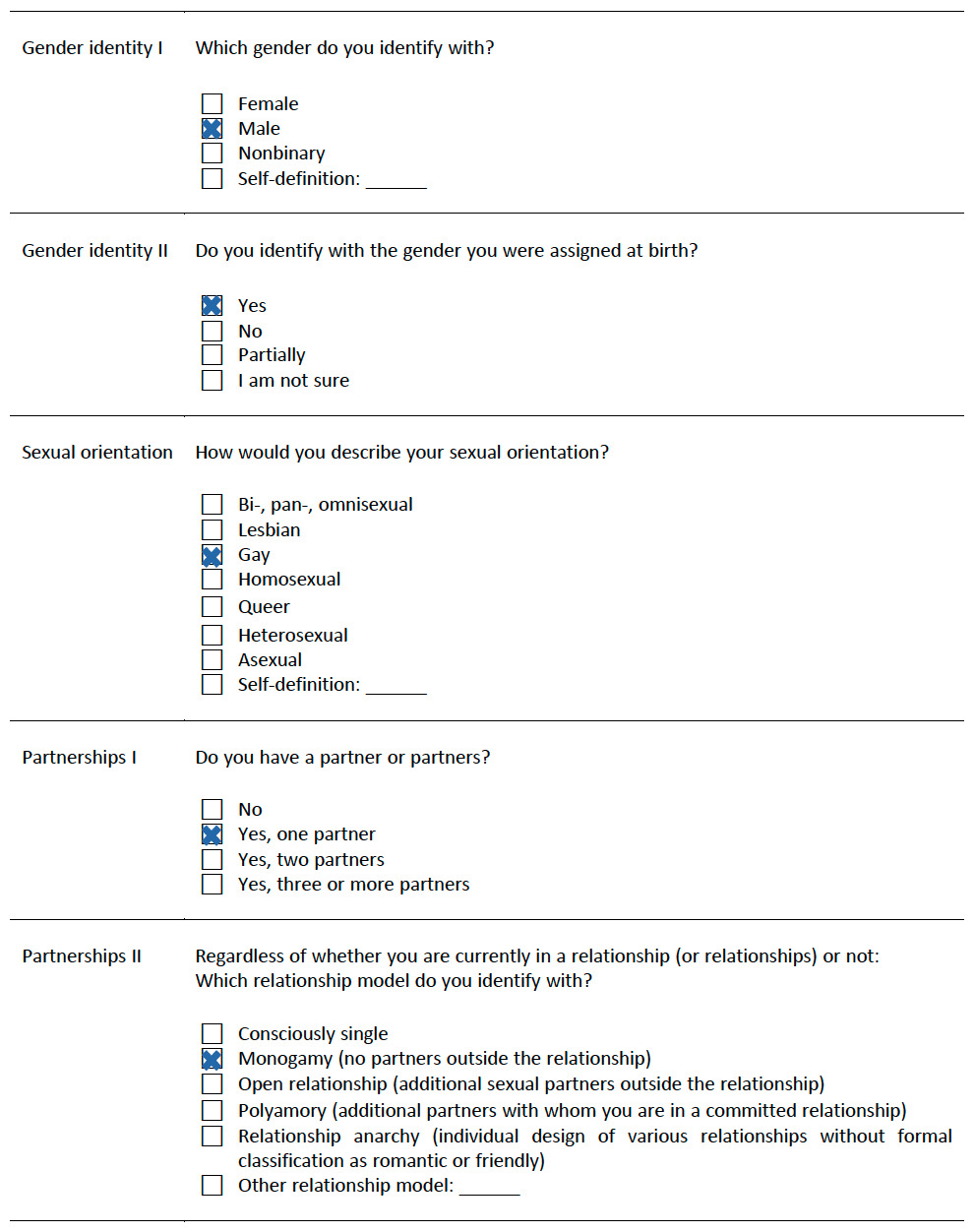
The survey starts with collecting demographic information about the respondent. Table 2 shows selected questions about the respondents’ sexual orientation and gender identity (SOGI) as well as partnerships and preferred relationship forms. Here, Guus would state that he is a cisgender homosexual male, living in a monogamous relationship with a partner.
Gender is a highly relevant dimension in family research. However, some studies do not ask about gender, instead using gender entries from registry data, which are usually recorded in binary form. Since registry data are not available in all countries, most studies include questions about current gender identity, gender assigned at birth, or both. Asking about assigned gender without context or recording gender in a binary way can lead to dropout among nonbinary participants (Diethold et al. 2023). To design-in queer realities, we have opted for a two-step gender query (Bates et al. 2022; Bornatici et al. 2025; Vries et al. 2024). First, we ask about current gender identity. Second, we ask whether the current gender identity matches the gender assigned at birth. Thereby, we can capture the current gender identity while ensuring comparability with studies using binary register data of assigned gender at birth.
The wording of questions, response categories, and their order is crucial as it can influence what is perceived as “normal” or socially desirable (Tourangeau 2018). Our wording choices are informed by current research and discourse within queer communities on identities and diverse family forms to ensure cultural and linguistic appropriateness. We do not only offer answer categories that match diverse realities and open fields for self-declaration but also show them in a way that reduces othering of non-normative experiences (D. R. Compton et al. 2018; Stadler et al. 2023). When asking about sexual orientation, we deliberately place answer categories, which have little visibility, such as bisexuals and lesbians (Rodríguez 2016; Soares et al. 2025), at the top.
.png)
Although acceptance of lesbian and gay relationships and patchwork families has increased, couple normativity (Teschlade et al. 2025) and the norm of monogamous relationships remain strong, particularly with regard to parenthood (Gupta et al. 2024). Large-scale family and household studies usually only ask whether the respondent is currently in a relationship (e.g., EFG, SHP in Table 1). Even if non-monogamy can be specified as a relationship type, further questions are only asked about one partner (e.g., Bujard et al. 2025). This means that multiple and non-hierarchical relationship types cannot be meaningfully recorded. In our survey, we ask about current partnerships on the one hand and about which (non-)monogamous relationship form the respondents live (or would like to live) on the other hand. This provides information about their current relationship networks and helps avoid drawing false assumptions about their preferred relationship form based on their current situation.
Although LGBTQIA+ individuals are often grouped together, they are not a homogeneous group (Drabent and Wenzel 2025). Besides SOGI indicators, the survey collects information on age, health, experiences of racialization, education, and the financial situation of respondents, that allow an intersectional analysis (Cho et al. 2013; Else-Quest et al. 2023).
4. Parenthood Beyond Biogenetics
Parenthood cannot be reduced to biogenetic kinship. Nevertheless, most surveys not focusing on families ask if the respondents have children without any further specification or limit the registration to biogenetic or adopted children (see examples in Table 1). However, when people enter into a partnership with someone already a parent, they often take on a parental role for their partner’s children without having a biogenetic or legal relationship with them. In addition to patchwork family settings, social parenthood is also becoming increasingly relevant with the further development and accessibility of assisted reproductive technologies (Chautems et al. 2025; Vaskovics 2020). Even when surveys include stepchildren and foster children (e.g., Generations and Gender Survey), respondents may be unsure how to answer questions about their parental role for children with whom they have no biogenetic or legal relationship.
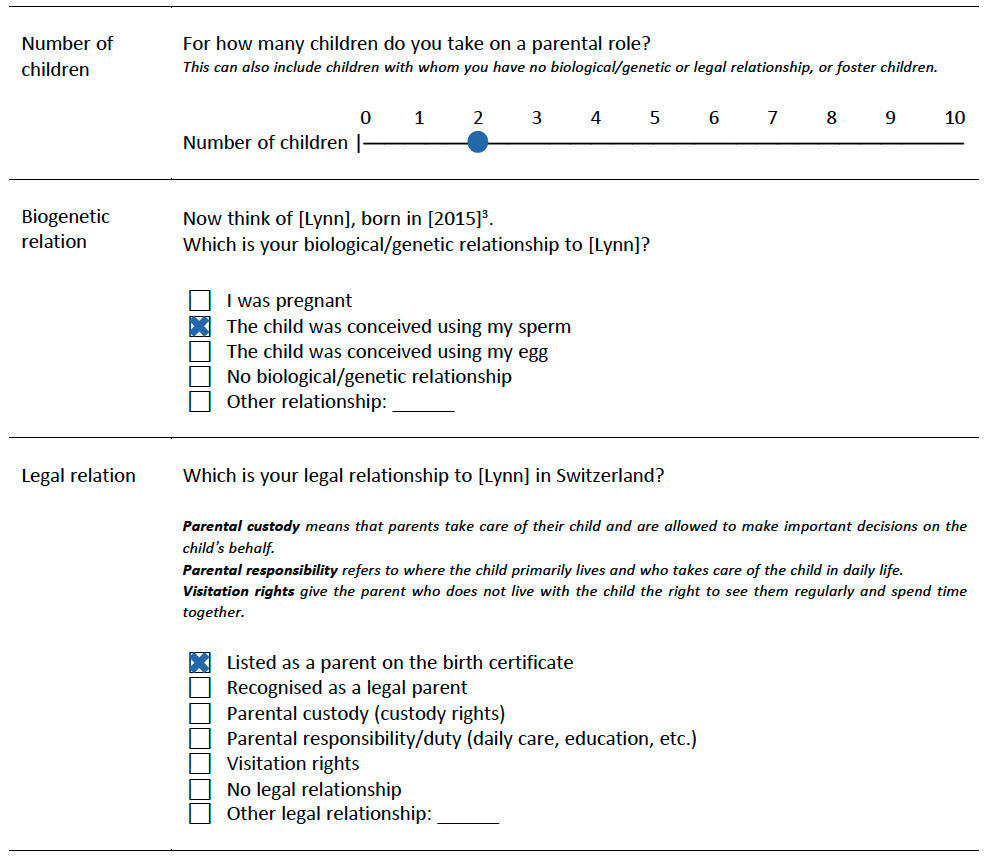
Table 3 shows selected questions about how our survey captures the respondents’ parent-child relations. In line with the perspective of complex families, we do not ask whether the respondents have children, but rather how many children they take on a parental role for. The recording of the family constellation continues with the registration of all children’s names, their genders, and years of birth. For the oldest and youngest child, we also record the biogenetic and legal relations with the respondent, as well as the point in time when the respondent assumed a parental role.
.png)
Answering detailed questions about complex family constellations and relationships takes time and can be emotionally draining. To keep the respondents’ burden low, we ask detailed questions about the participants’ relations to their oldest and youngest child only. Following trans-inclusive formulations, we ask not only whether, but also what kind of biogenetic parent-child relationship exists. Additionally, the qualitative research showed that the reception of oocytes from the partner (ROPA) is becoming increasingly relevant for lesbian couples, enabling both partners to have a biological relationship with the child (Brandão and Ceschin 2023; Chautems et al. 2025). In order to reflect this reality, we separate the biological bond through pregnancy from the genetic relationship through the egg cell.
The legal relationships between parents and children are usually only examined in cases of separation (e.g., EFG). Qualitative research reveals a variety of legal arrangements between co-parents who may not have been in a partnership with one another (Ammann and Miller 2025; Teschlade et al. 2025). Furthermore, a parent-child relationship may not yet be recognized in Switzerland, for example, in the case of (stepchild) adoption (Schmaltz 2020). It is therefore important to examine all possible legal and social relationships in a given context. Because these categories are possibly unclear, we have added a brief explanatory text.
Coming back to our example, in this part, Guus states that he has two children. He is the biogenetic father of his daughter, Lynn, and being listed as the father on her birth certificate. He is also the father of his daughter Sophie, but he has no biogenetic or legal relationship to her.
5. Parenting Arrangements
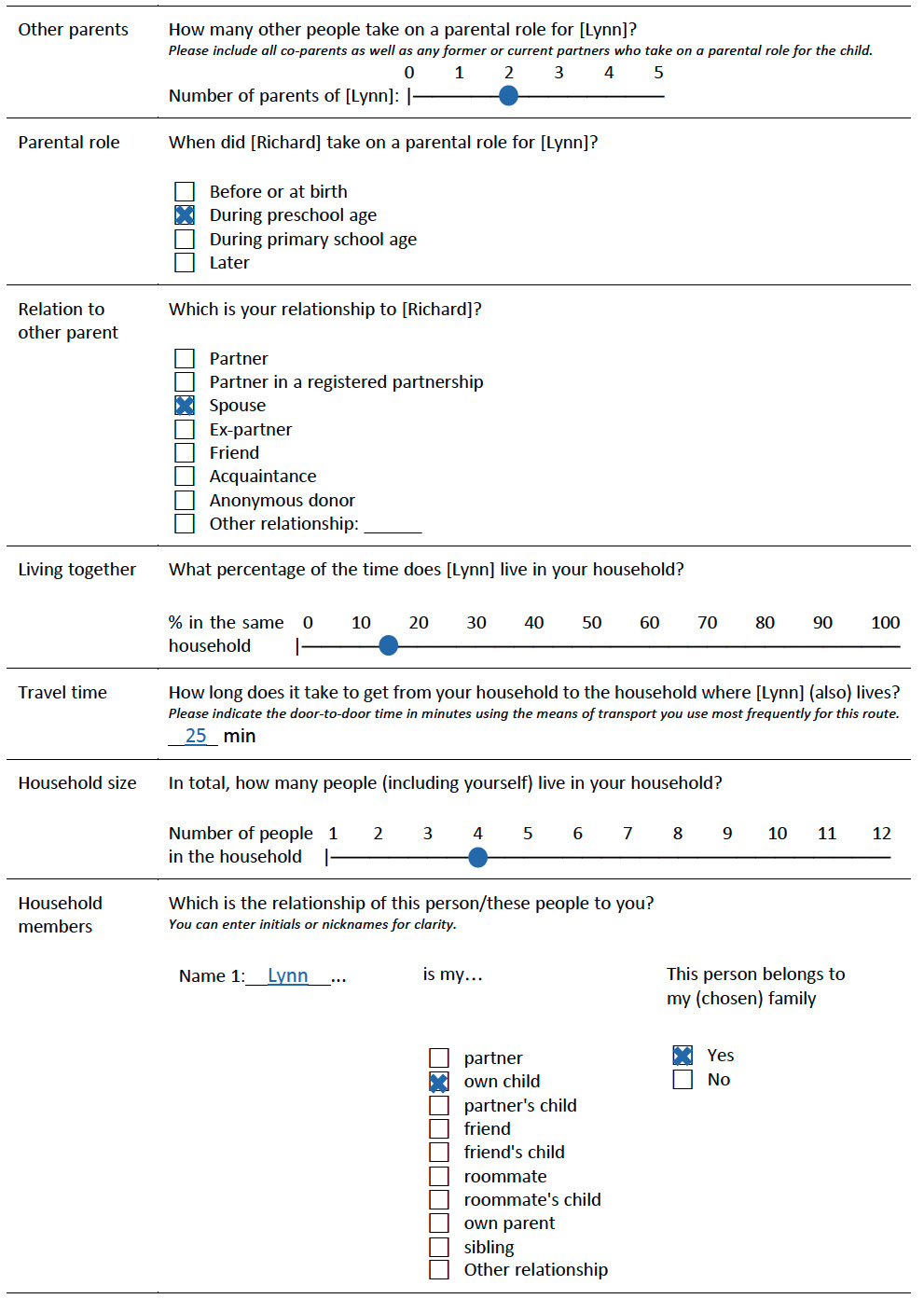
The qualitative interview examples revealed co-parenting arrangements involving up to a maximum of four parents (see Table 4). In the survey, we decided to ask about up to six parents in order to fully capture larger parenting arrangements, e.g., when new partners are involved. As parenting arrangements change, it is important to know when the parental role was assumed. To make it easier for respondents, we provide four response categories that refer to relevant stages in the child’s life, known as ‘temporal landmarks’ (Loftus and Marburger 1983).
In addition, we record the relationship between the respondent and the other parents. This question clearly shows that disjointed and exhaustive response categories often reach their limits when attempting to capture complex family relationships (Grzanka 2019; Pascoe 2018): For example, ex-partners can become friends, acquaintances can become family members through co-parenting, and new partners can start taking on parenting responsibilities. In our survey, several answer options can be selected for many questions, and own answers can be specified in the “other” field.
Guus lists Ingrid as Lynn’s biogenetic and legal mother since birth, and Richard as the social father since birth. He also states that Ingrid is a cisgender, heterosexual woman, and an acquaintance of his, and that Richard is cisgender male, homosexual, and his spouse. For Sophie, Marloes is recorded as the biogenetic and legal mother, who is also a cisgender and heterosexual woman. Richard is recorded as the biogenetic father. Before birth, it was clear that Guus and Ingrid were Lynn’s co-parents. However, it quickly became apparent that Richard, as Guus’s partner, also played a parental role for Lynn. He therefore states that Richard took on a parental role for Lynn during preschool age.
.png)
Since our survey focuses on parenthood, we have chosen a design that first captures all parent-child relationships within a family constellation and then collects further information. The recording of living arrangements is part of the survey section on caring arrangements. Instead of assuming that parents and children live together, we ask what percentage of the time a child lives in the respondent’s household. If this is less than 100%, the distance between the two households is recorded by the average travel time, ensuring comparability with other family studies (e.g., EFG).
To include diverse family constellations and living arrangements, we ask about all members of the household and their relationship to the respondent. The latter can indicate whether the co-residents belong to their (chosen) family or not. This ensures that our data remain comparable with traditional household surveys while also exploring areas where the latter fail to fully capture complex (queer) family and household structures.
6. Conclusion
Categorizing family forms and relationships that do not conform to prevailing social norms is a challenge. This article shows how the integration of qualitative insights enhances our understanding of capturing complex family constellations. Our survey Queer Families in Switzerland maps parenting arrangements beyond nuclear family models and across households and accommodates multi-parent structures, non-biological caregiving relationships, and multiple, non-hierarchical relationships.
In the survey development, complex family constellations, known from the qualitative research served as a benchmark for testing whether the standardized survey records family structures meaningfully and completely. Balancing tensions between reducing normativity and ensuring connectivity, capturing complexities and minimizing respondent burden, we outline how a language-sensitive, inclusive survey can bridge traditional large-scale survey family research, and include lived realities of non-normative people and families. The survey on queer families provides valuable insights not only for research into queer parenthood but for all individuals, relationships, and families who are challenging the narrow norms regarding gender, partnerships, and families. If we want to understand how all families are affected by legal development and social norms, we must challenge taken-for-granted assumptions about families.
Mixed-methods approaches with queer families entail both the challenges and opportunities of qualitative and quantitative research, underscoring the need for methodological reflexivity and meaningful engagement with marginalized communities. Our ‘sandwich method’—which moves from a qualitative phase to a quantitative phase and back, with each informing the next—not only facilitates cross-checking and triangulating the data, but also enables targeted survey design. Anticipating subsequent qualitative inquiry to probe salient themes emerging from the questionnaire, we could confidently “kill our darlings” by prioritizing breadth where quantitative data were most needed, while advocating continued innovation in questionnaire design to ensure equitable representation of diverse family constellations in social research.
Corresponding author contact information
Tamara Bosshardt, tamara.bosshardt@unilu.ch
Carole Ammann, carole.ammann@unilu.ch
Leo Valentin Theissing, leo.theissing@unilu.ch
University of Lucerne, Frohburgstrasse 3, 6002 Luzern
The survey is part of the project Queer Family Research, launched in September 2024 and located at the University of Lucerne. Its central aim is to investigate how queer parents understand, experience, negotiate, and enact parenting within social, legal, political, and economic structures that privilege heterosexual, cisgender, two-parent family models. The project pays attention to the ways in which intersecting axes of difference—such as sexual orientation, gender identity, class, race, language, religion, and age—shape parenting ideals, experiences, and practices.