Introduction
This special issue of Survey Practice celebrates a mixed methods approach to research design with the intent of deepening the researcher’s understanding of the research question compared to a quantitative-only or qualitative-only design. Mixed methods research “involves collecting and analyzing both quantitative and qualitative data, placing these two databases in a set of procedures or designs, analyzing results from both forms of data, and then engaging in further analysis by drawing insight from the connection between the two databases” (Creswell and Inoue 2025, 4). The linking or integration of quantitative with qualitative data is central to the adoption of a mixed methods research design.
The added value of a research design that combines quantitative and qualitative methods is multifaceted. From a professional standpoint, mixed methods research serves to deepen the researcher’s commitment to their research objective by way of expanding the methodological framework and their understanding of the relevant attitudes and behavior. Mixed methods research also deepens the researcher’s ability to embrace underrepresented and marginalized segments of the population, as well as to investigate sensitive issues.
From a practical and quality standpoint, mixed methods research design strengthens:
-
triangulation – the ability to corroborate results from different methods;
-
clarification – helping to explain the results from one method with the results from another method;
-
development – informing the development of one method, such as a survey questionnaire, with the results of another method, such as qualitative in-depth interviews; and
-
expansion – the opportunity to expand the scope of the research inquiry with the integration of quantitative and qualitative methods.
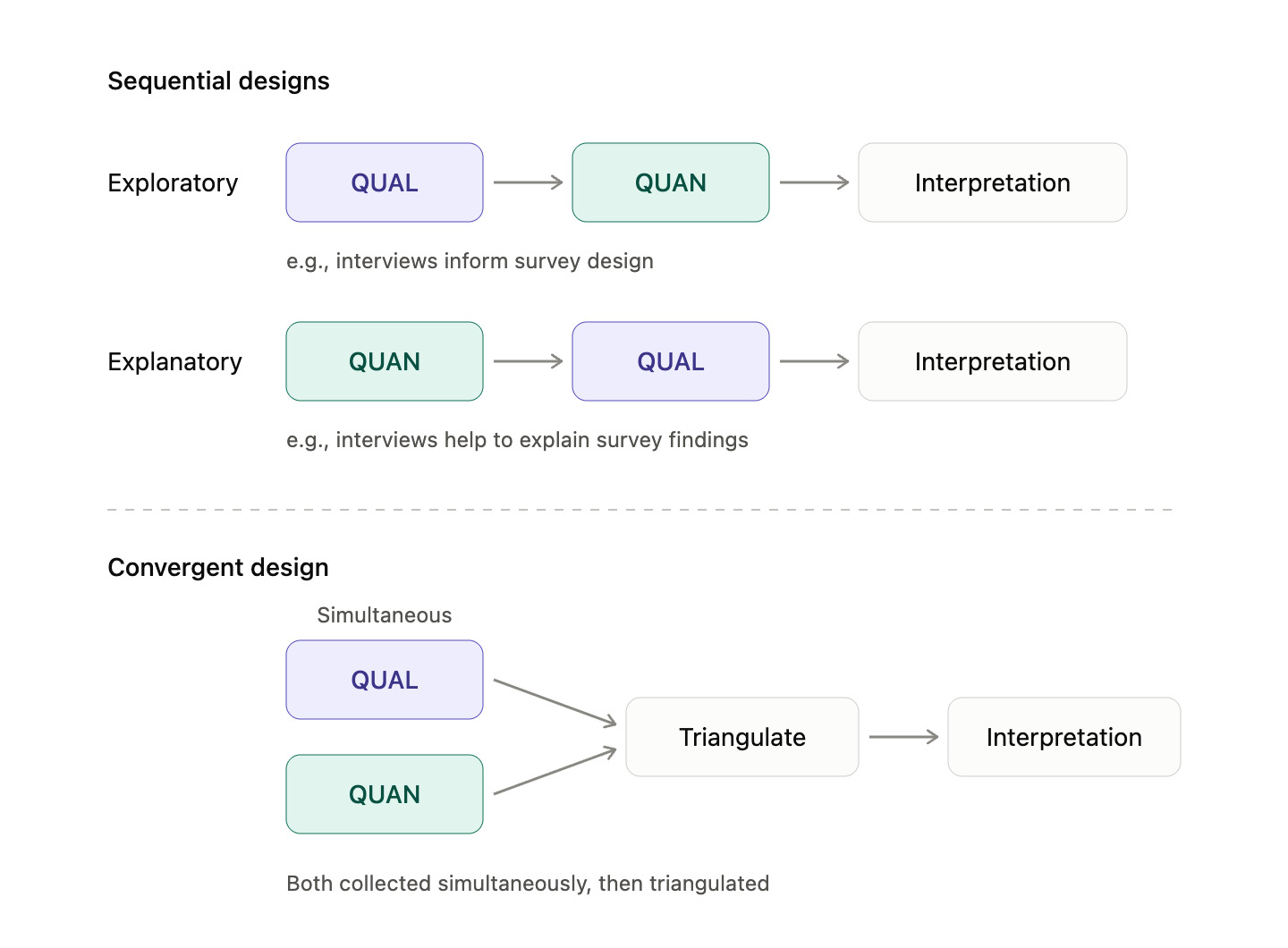
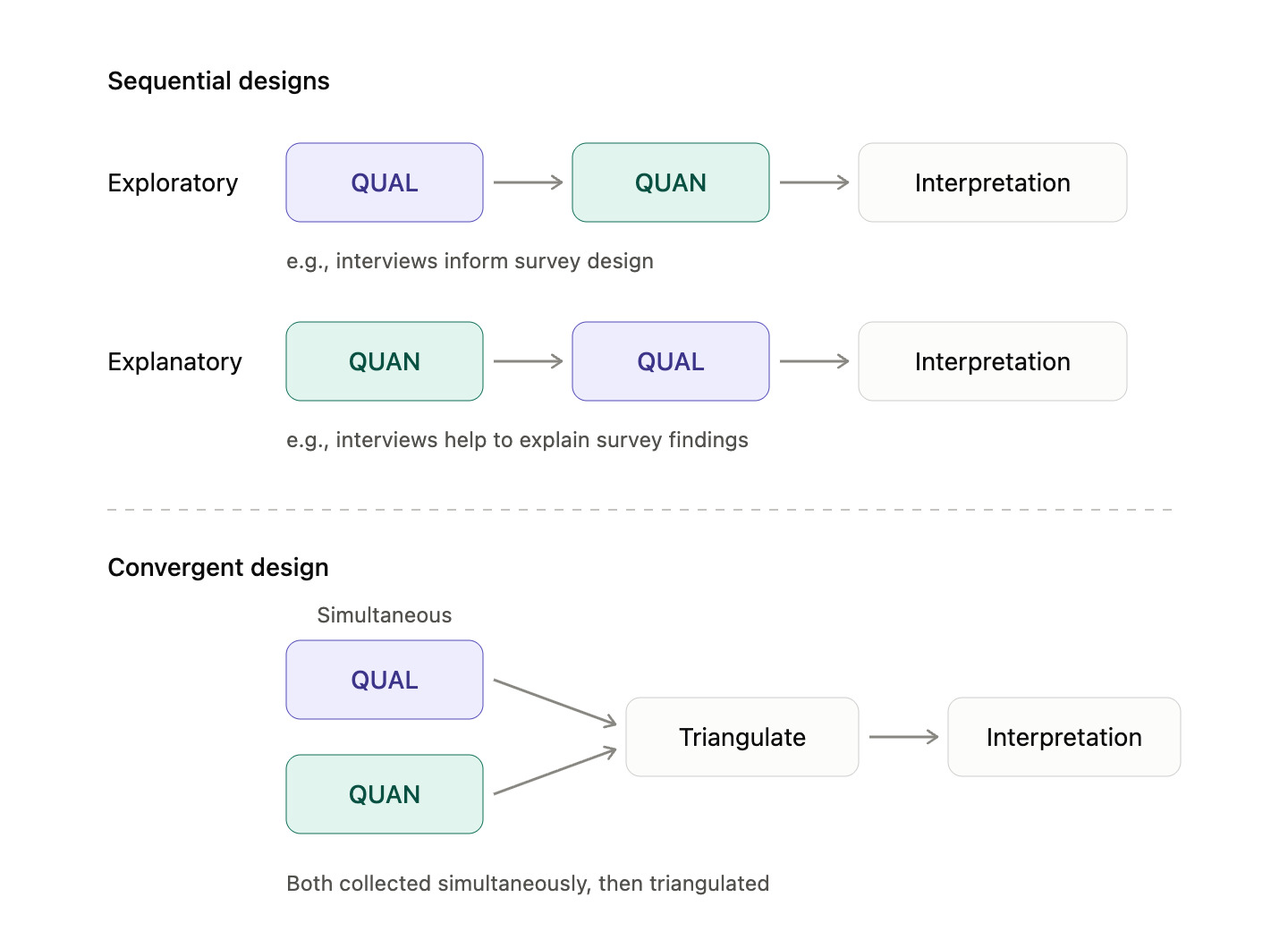
There are two general categories or types of mixed methods designs – sequential and convergent – that represent ways to integrate quantitative and qualitative methods within a mixed methods research design (Creswell and Plano Clark 2018). Sequential designs are further defined by whether they are “exploratory,” whereby the qualitative component is executed prior to quantitative research (e.g., to aid in survey questionnaire design) or “explanatory,” where qualitative research occurs after the quantitative phase (e.g., to help explain, give more depth to survey data). Convergent mixed methods research involves designs in which quantitative and qualitative data collection and analysis are conducted simultaneously then merged to contrast and compare outcomes to derive an integrated interpretation. See Figure 1.
Editorial Decision Process
The call for papers for this Survey Practice special issue asked authors across disciplines to submit their mixed methods research, including exploratory, explanatory, and convergent designs. The emphasis for this special issue is on articles that demonstrate that a mixed methods approach better informed the researcher’s understanding of the research question compared to quantitative-only or qualitative-only designs. Another important consideration was including articles on topics likely to be of interest to Survey Practice readers and inspire their own research.
As a first step towards reviewing submissions that were not desk rejected, one of the co-editors or another Associate Editor reviewed each submission for the special issue. If one of the co-editors completed the initial review, the other co-editor and Editor-in-Chief then reviewed the original reviewer’s comments and added further comments as needed. If another Associate Editor completed the initial review, both co-editors and the Editor-in-Chief examined the manuscript and evaluated the substantive content as well as necessary editorial modifications.
Through this process, the editorial team confirmed that (1) each article submission used sound qualitative and quantitative research methods, (2) each article submission demonstrated that a mixed methods approach better informed the researcher’s understanding of the research question compared to quantitative-only or qualitative-only designs, (3) each article submission focused on a topic of interest to Survey Practice readers, and (4) authors of each article submission satisfactorily addressed comments from all reviewers. The co-editors recommended, and the Editor-in-Chief accepted for publication, all submitted articles that fully met these criteria. All acceptance decisions were unanimous among the co-editors and the Editor-in-Chief.
Articles Included in This Special Issue
There are 15 articles included in this special issue of Survey Practice, including 14 full papers and one in-brief note. These articles are diverse in terms of topic areas and research objectives as well as mixed methods typology. Looking across these 15 articles, four broad areas of subject matter emerge – that is, research pertaining to (1) youth and families, (2) health and healthcare, (3) hard-to-reach and vulnerable segments of the population, and (4) survey development – plus two “other” articles that fall outside these categories.
Youth and Families
In their article concerning family constellations, Bosshardt, Theissing, and Ammann discuss a sequential-exploratory mixed methods design in which qualitative in-depth interviews with queer parents played an essential role in deepening their understanding of how best to capture complex family constellations in survey design. This aided the development of the Queer Families in Switzerland survey, which focuses on parenting arrangements beyond nuclear family models.
A sequential-exploratory mixed methods design was also used by Silver, Rapaport, and Rabinovich to explore the causes leading to school absenteeism among students. These researchers began by conducting 40 in-depth interviews with parents of school-age children from the Understanding America Study (UAS), a probability-based nationally representative survey panel. These interviews identified key drivers of absenteeism and informed the development of a survey that was conducted with parents of K-12 children as well as all members of the UAS teen panel.
Two articles in this special issue specific to youth and families discuss the implementation of convergent mixed methods research designs. Kaplan, Walker, and Morrison used a combination of methods to assess the clarity and effectiveness (i.e., willingness to participate) of the informed consent materials associated with the National Longitudinal Survey of Youth.[1] These methods included an unmoderated web survey among parents with youth in the age groups of interest (11-14 and 15-17), family interviews with a mix of parents and youth ages 11-14 and ages 15-17, and intercept testing with 31 youth at two schools and a public library.
Corry et al. investigated youth career planning by way of a convergent mixed methods design that combined semi-structured in-depth interviews with 40 young adults aged 18-30 to guide questionnaire design, with a follow-up web-based survey among teens and young adults aged 13-30, using NORC’s AmeriSpeak® probability-based panel, as well as 60 additional qualitative interviews with young adults aged 18-30 who completed the AmeriSpeak survey to cognitively test survey items and explore additional constructs of interest. The results of this research will lead to the development of a national survey concerning educational and career decision-making among young adults in the US.
Health and Healthcare
Three articles in this special issue discuss research pertaining to health-related behavior and programs. Each of these articles discusses one of the three unique mixed methods designs (see Figure 1). In their article, Sandberg and Delaunay showcase an iterative sequential-exploratory study they conducted as part of the Niakhar Social Networks and Health Project (NSNHP). The goal of this research was to investigate the connection between social network characteristics and health beliefs and behaviors in a rural Senegalese population. This study began with in-depth interviews and focus group discussions to better understand sociability and types of social interaction within the study zone. This was followed by pilot testing and validation surveys which were then followed by in-depth interviews to explore the cognitive schemas of health and illness. The iterative insights from these research phases were integrated into the main NSNHP survey resulting in a robust survey instrument.
A sequential-explanatory approach was utilized by Stevens et al. to address the shortage of direct care professionals (DCP) in West Virginia and, specifically, to explore the impact of three training lengths on DCP employment after training and trainees’ experiences. The study began with the quantitative phase, including five surveys that were designed for each phase of the training process (from registration to six weeks after training). The results from the two-week and six-week surveys informed the guide development for each of five groups of trainees from which in-depth interviews were conducted. Given the number of challenges these authors faced, they emphasize the value of the flexible mixed methods design of their study.
The Centers for Disease Control and Prevention’s Hear Her health communication campaign – which is designed to raise awareness of urgent maternal warning signs among pregnant and postpartum women (PPW) and support people (SP) – is the focus of the research discussed in the Greene et al. article. To assess the awareness and effectiveness of this campaign, researchers recruited nationally representative probability samples of PPW and SP for surveys and, from these samples, the research team purposively selected participants for individual interviews. This convergent mixed methods design resulted in “a rigorous and contextually rich solution” to achieving the research objectives.
Hard-to-reach and Vulnerable Segments of the Population
As in healthcare, each of the three articles related to hard-to-reach and vulnerable segments of the population in this special issue presents research following one of the three basic types of mixed methods designs (see Figure 1). A sequential-exploratory design was adopted by Boidi et al. to inform an Adaptive Cluster Sample approach to sampling Venezuelan migrant households across two different Latin American countries, Columbia and Peru. The researchers began by examining official administrative records followed by in-depth qualitative interviews with leaders of local migrant-serving organizations. The interviews enabled these researchers to identify geographic units of Venezuelan migrants, refine eligibility criteria, and choose the basis by which to initiate and terminate adaptive expansion. This aided in the development of the fieldwork protocol for the pilot studies that led to increased fieldwork efficiency and respondent contact rates.
Horwitz and Kotler-Berkowitz implemented a sequential-explanatory mixed methods research design to examine economic vulnerability among the American Jewish population. Their research began with a quantitative phase utilizing a dual-panel online survey approach resulting in responses from 1,958 self-identified Jewish adults. To help elucidate the survey data and identify broader themes, 175 survey respondents participated in follow-up in-depth interviews. Then, to add a different perspective, additional interviews were conducted with human service professionals who serve economically vulnerable Jewish clients.
A convergent mixed methods and mixed-paradigm (deductive and inductive) research design was utilized by Valdez-Dadia et al. to explore cross-cultural differences and quality of life factors associated with the diagnosis of breast cancer among made-to-be vulnerable and underserved populations. These researchers studied three Asian American communities (Chinese, Japanese, and Vietnamese) across three geographic regions (Northern California, Southern California, and Southeastern Texas), conducting focus group discussions, in-depth interviews, and survey research simultaneously. This article offers practical methodological guidance for researchers working with hard-to-reach populations.
Survey Development
Three of the 15 articles in this special issue of Survey Practice discuss a sequential-exploratory mixed methods approach with the specific aim of furthering the development of the survey materials. Angrisani et al. discuss their use of this design method to improve the invitation letter used for recruitment into the Understanding America Study (UAS), a nationally representative probability-based online panel. The qualitative phase was iterative, beginning with focus group discussions for general insights followed by in-depth interviews to gain more detailed feedback on the UAS invitation letter. The outcomes of these qualitative methods were incorporated into an experimental survey evaluation of the impact of the revised invitation letter on recruiting participants to the UAS survey panel.
Another methodology to inform survey research is the Qualitative Pretest Interview (QPI). As discussed by Hunsicker and Bethmann, QPIs are intended to reduce measurement error and improve the validity of quantitative analyses by treating QPI participants as co-experts in a dialogical process. These researchers utilized QPIs with the goal of improving the validity of the IT module of the Survey of Health, Ageing and Retirement in Europe, as well as evaluating the feasibility and effectiveness of QPIs in a multinational, large-scale context.
Sezgin-Just et al. use a sequential-exploratory design to develop and then test a tailored motivation and communication strategy for people with Turkish citizenship in Germany with the goal of fostering initial and continued participation in a multi-thematic panel study. Their approach began with expert interviews with community leaders, as well as focus groups and cognitive pretests with persons of Turkish family background. The results of this qualitative phase – which highlighted issues of trust and questions of belonging – will directly inform the design of survey materials that will be tested in the second phase of the project.
Artificial Intelligence and Social Media Engagement
This special issue also includes two articles that present sequential-exploratory mixed methods research designs to examine specific topic areas that do not fall into the previously discussed categories. Mitra et al. conducted a sequential-exploratory study to answer the question, “How can we better understand the impact of artificial intelligence on federal government agencies?” This research began with a literature review followed by in-depth interviews with subject matter experts followed by a web-based survey. This multistage investigation led to actionable next steps towards reaching the objective.
The goal of the research discussed by Hogenboom-Jones was to assess short video platform use by developing and testing best-practice self-report measures that capture both frequency and duration of social media engagement. The initial cognitive interviews conducted in the development process revealed that respondents had high confidence and ease in responding to multi-dimensional self-report items, ultimately leading to a decrease in respondent burden. These results were verified by way of a survey experiment.
Acknowledgements
This special issue would not have been possible without the tremendous support the co-editors received from the Survey Practice Associate Editors and the Editor-in-Chief, Eva Aizpurua. Their prompt and thorough attention to each detail of the review process resulted in a quality issue magnifying the role of mixed methods in research design. We also want to thank the American Association for Public Opinion Research for their dissemination of Survey Practice and overall support.
Corresponding author contact information
Margaret R. Roller
rmr@rollerresearch.com
Two cohorts, originating in 1979 and 1997, are ongoing, with a new cohort launching in the coming years. The link for 1979 is https://www.bls.gov/nls/nlsy79.htm and the link for 1997 is https://www.bls.gov/nls/nlsy97.htm.